

Why Your Business Success Starts in Your Mind
Mindset coaching for entrepreneurs is a specialized form of coaching that helps business owners identify and overcome mental blocks, limiting beliefs, and negative thought patterns that hold back their business growth. Unlike traditional business coaching that focuses on strategy and tactics, mindset coaching addresses the psychological barriers that prevent entrepreneurs from taking bold action and achieving their full potential.
What mindset coaching covers:
– Limiting belief identification – Finding thoughts like “I’m not good enough” or “I can’t charge premium prices”
– Confidence building – Developing unshakeable self-belief in your abilities and vision
– Fear management – Overcoming imposter syndrome, fear of failure, and perfectionism
– Decision-making clarity – Breaking through overwhelm and analysis paralysis
– Resilience training – Building mental toughness to handle setbacks and stress
The life coaching industry is now worth over $1 billion in the United States alone, with nearly half the workforce projected to be self-employed. Strategic Coach members report dramatic results: 8× increases in net worth, doubled business size, and 190+ days off per year while earning more.
Research from the International Coach Federation shows that approximately 80% of coaching effectiveness comes from mindset work, not tactics or strategy. Your brain weighs about three pounds, but it controls everything – how you react to rejection, whether you take calculated risks, and if you’ll push through when things get tough.
Brain plasticity research proves you can rewire these patterns. Entrepreneurs who invest in mindset coaching report completing stalled projects in 30 days, increasing pricing by 10×, and building businesses that run without constant stress and burnout.
Why Mindset Makes or Breaks a Business
Picture this: Two entrepreneurs launch identical businesses on the same day. Same product, same budget, same market conditions. Six months later, one is thriving while the other is ready to quit. What’s the difference?
It’s not luck. It’s not connections. It’s mindset.
Your thoughts literally shape your reality. When you believe you’re capable of charging premium prices, you do. When you trust your decision-making abilities, you act faster than competitors who second-guess themselves. When you see setbacks as learning opportunities instead of failures, you bounce back stronger.
With nearly half the workforce projected to become self-employed according to Intuit research, we’re seeing a massive shift. Yet most new entrepreneurs focus entirely on strategy while ignoring the mental game that determines whether those strategies actually get implemented.
Mindset coaching for entrepreneurs addresses this gap. Research shows that approximately 80% of coaching effectiveness comes from mindset work, not tactics. That’s because all the best strategies in the world won’t help if you’re too scared to execute them.
The Brain Behind Bold Moves
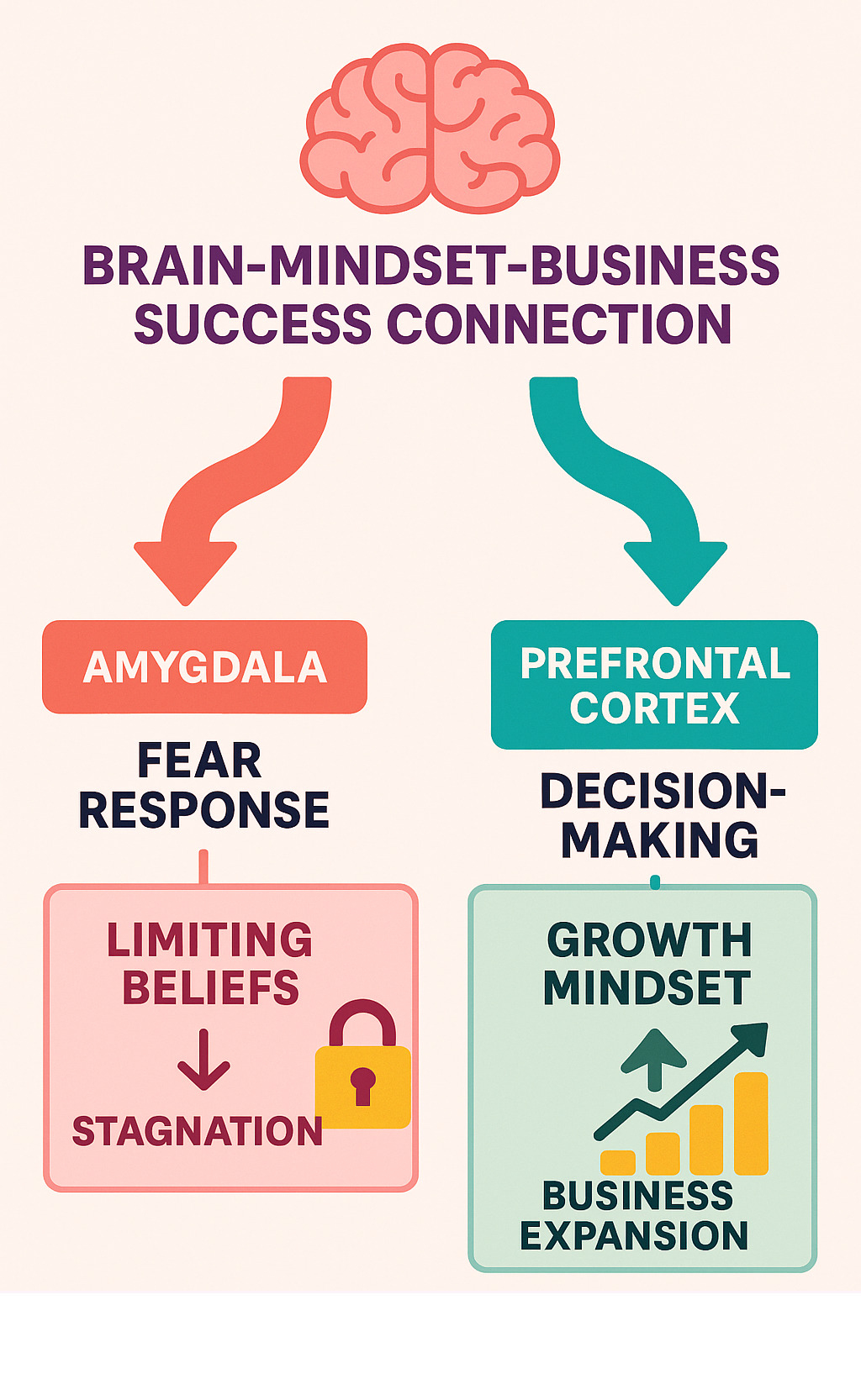
Your brain has two main players when you face big business decisions. The amygdala – your inner security guard – scans for threats 24/7. When you consider launching that new product, it shouts warnings: “What if you fail? Play it safe!”
Then there’s your prefrontal cortex – the wise CEO of your brain. This is where logical thinking happens. It analyzes data, weighs options, and makes strategic decisions.
The problem: the amygdala is both faster and louder. Without proper training, fear response wins by default. You end up stuck in analysis paralysis or avoiding opportunities altogether.
The exciting part? Your brain is changeable. Neuroscience research proves you can literally rewire these habit loops through consistent practice. Entrepreneurs who train their minds develop “cognitive flexibility” – choosing responses based on facts, not feelings.
Tangible Payoffs of a Winning Mindset
Strategic Coach members report incredible outcomes: 8× increases in net worth while doing work they love, businesses that double in size, and 190+ days off per year while earning more than ever.
The time freedom alone is worth the investment. Instead of working 80-hour weeks and burning out, entrepreneurs with strong mindsets work smarter. They make decisions faster, delegate more effectively, and focus on high-impact activities.
But the benefits go beyond money. Entrepreneurs report better relationships, more creative breakthroughs, and genuine confidence that doesn’t depend on external validation.
For more strategies on managing the mental challenges of entrepreneurship, check out our guide on Entrepreneur Stress Management.
The bottom line? Your mindset isn’t just part of your business – it is your business.
Mindset Coaching for Entrepreneurs: Definition & Framework
Mindset coaching for entrepreneurs isn’t therapy or traditional business consulting. At its core, it’s identity work – helping you bridge the gap between who you are now and who you need to become to achieve your biggest goals.
The process typically involves:
1. Belief Archaeology: Digging up limiting beliefs like “I’m not smart enough to scale” or “Successful people are just lucky.”
2. Pattern Interruption: Using techniques like NLP (Neuro-Linguistic Programming) or EFT (Emotional Freedom Technique) to neutralize negative thought patterns.
3. Identity Reconstruction: Building new neural pathways that support your entrepreneurial vision through genuine rewiring based on evidence and experience.
4. Accountability Systems: Creating structures that keep you consistent with new thought patterns and behaviors.
Many successful coaches use “coach-sulting” – combining traditional coaching questions with strategic consulting advice, providing frameworks and tools while empowering you to make your own decisions.
How Mindset Coaching for Entrepreneurs Differs From Traditional Business Coaching
Traditional business coaching focuses on the “what” and “how” – strategies and execution. Mindset coaching for entrepreneurs focuses on the “who” and “why” – who you need to become and why your current identity might be sabotaging your success.
| Traditional Business Coaching | Mindset Coaching for Entrepreneurs |
|---|---|
| Focus on external strategies | Focus on internal barriers |
| “Here’s what to do” | “Here’s why you’re not doing it” |
| Tactical implementation | Identity change |
| Quarterly business reviews | Daily thought pattern shifts |
| ROI measured in revenue | ROI measured in fulfillment + revenue |
| Problem-solving approach | Root cause healing approach |
A business coach might help you create a marketing funnel. A mindset coach helps you overcome the fear of being visible that’s preventing you from promoting that funnel.
Benefits of Mindset Coaching for Entrepreneurs
Clarity: Instead of feeling overwhelmed by endless options, you develop laser focus on what matters most. One entrepreneur shared: “The clarity helped me finish a stalled book in 30 days.”
Confidence: Genuine self-assurance based on aligned action. Clients report showing up authentically in sales conversations and leadership situations.
Work-Life Integration: Strategic Coach members enjoy an average of 190+ days off per year while growing their businesses.
Resilience: Building your capacity to handle inevitable setbacks without losing momentum.

Overcoming Common Entrepreneurial Mindset Blocks
Let’s talk about the mental gremlins that keep ambitious entrepreneurs playing small:
Imposter Syndrome: That nagging voice saying “Who am I to charge premium prices?” One coaching client overcame this to transition from copywriter to high-ticket consultant.
Procrastination: The perfectionist kind where you keep researching and planning instead of launching because “it’s not ready yet.”
Analysis Paralysis: Getting stuck in “what if” loops instead of making decisions, missing opportunities entirely.
Fear of Failure: Ironically leading to the very failure you’re trying to avoid by not taking necessary risks.
Money Blocks: Deep-seated beliefs about money being “dirty” or not deserving wealth, sabotaging pricing and scaling efforts.
Diagnostic Tools & Inventories
MindsetMaps™ Inventory: This scientifically modeled assessment compares your actual mindset against your ideal mindset. Over 5,467 entrepreneurs have taken this inventory, with many reporting breakthrough insights within minutes.
Pre-Session Questionnaires: Structured questionnaires focus each session with questions like “What’s your biggest challenge right now?” and “What would you do if you knew you couldn’t fail?”
Journaling Prompts: Regular self-reflection through targeted questions reveals limiting beliefs in real-time.
For entrepreneurs who want to explore this further, our guide on Journaling for Entrepreneurs provides specific prompts and frameworks for mindset work.
Coaching Techniques That Neutralize Limiting Beliefs
The Rubber Band Snap Hack: Wear a rubber band around your wrist and snap it every time you catch negative self-talk. The physical sensation interrupts the neural pathway.
EFT (Emotional Freedom Technique): “Tapping” involves stimulating specific acupressure points while focusing on limiting beliefs. Research on trauma release and anxiety reduction is compelling.
Timeline Therapy: This NLP technique helps trace limiting beliefs back to their origin, often in childhood experiences.
Visualization with Emotion: Not just imagining success, but feeling the emotions of achievement.
The Mental Detox Method: Used by over 1,500 coaches, this approach helps entrepreneurs become “mentally and emotionally unstoppable.”

Choosing (and Measuring) the Right Coach
Not all coaches are created equal. Here’s how to find someone who can actually move the needle.
Credentials Matter: ICF (International Coach Federation) certification shows formal training, but doesn’t guarantee results. Look for coaches who combine certification with real-world business experience.
Results Over Rhetoric: Look for specific case studies and measurable outcomes. Can they show clients who’ve doubled revenue or overcome specific fears?
Chemistry Calls Are Essential: Most reputable coaches offer findy calls to assess fit. Use these to evaluate their communication style and industry understanding.
Investment Alignment: Mindset coaching packages typically start around £8,000 for comprehensive programs. The investment should feel significant enough to motivate change but not create financial stress.
How to Vet a Mindset Coach
Values Alignment: Your coach should embody the qualities you want to develop. If you value work-life balance, don’t hire someone who brags about working 80-hour weeks.
Niche Expertise: Generic life coaches often lack specific understanding of entrepreneurial challenges. Look for coaches who specialize in business owners.
Methodology Transparency: Good coaches can explain their approach clearly, whether they use NLP, timeline therapy, or proprietary frameworks.
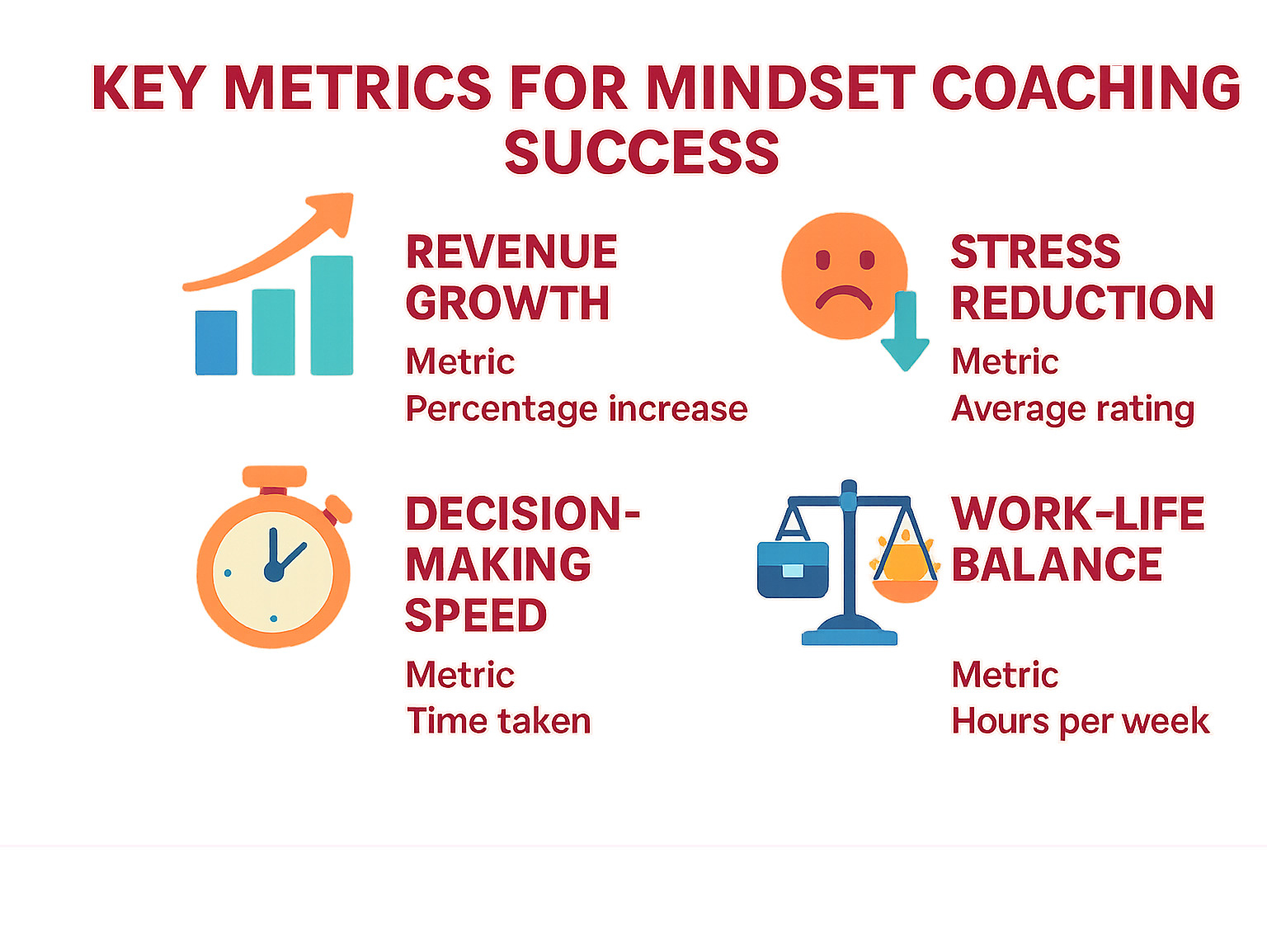
Metrics to Gauge Progress After Mindset Coaching for Entrepreneurs
Revenue Trends: Track monthly revenue, average transaction size, and client retention rates.
Decision-Making Speed: Measure how quickly you make important business decisions.
Stress and Energy Levels: Use a simple 1-10 scale to track daily stress and energy.
Time Allocation: Are you focusing on high-impact activities or getting stuck in busy work?
Days Off: Strategic Coach members average 190+ days off per year – track your own rest patterns.
For entrepreneurs struggling with burnout, our comprehensive guide on Burnout Prevention for Entrepreneurs provides additional strategies.
DIY Mindset Shifts & Next Steps
You don’t need to wait for a coach to start rewiring your brain. Think of these techniques as mental push-ups – simple exercises that build psychological muscle over time.
Start with a morning manifesto – a daily declaration of your vision and goals. Write down specific, emotionally charged objectives and read them every morning and night. One entrepreneur used this practice to complete a two-year book project in just 30 days.
Combat negativity bias with a daily wins log. Each night, write down every victory from the day, no matter how small. Made that difficult phone call? Win. Sent the avoided email? Win.
Visualization works when done right. Spend 5-10 minutes daily imagining your ideal business with full sensory detail. The more vivid and emotional, the more your brain treats it as real experience.
Meditation and mindfulness improve focus, reduce anxiety, and increase emotional regulation. Even 10 minutes daily of simple breath awareness trains the mental muscle needed for sustained business focus.
Quick-Start Exercises
Try the 5-minute fear inventory right now. Write down every fear about your business, then mark each as “realistic concern” or “mental noise.” You’ll be amazed how much stress comes from imaginary problems.
Commit to a 21-day mindset challenge: Read your vision statement each morning, snap a rubber band when you catch negative self-talk, and write three wins before bed.
Find an accountability buddy – another entrepreneur serious about mindset work. Check in weekly to share goals and victories.
For additional structured approaches, check out our guide on Personal Development Books that can accelerate mindset change.
When to Level Up to Professional Mindset Coaching for Entrepreneurs
Revenue plateaus are often mindset issues in disguise. If you’ve been stuck at the same income level for six months despite trying new strategies, the problem isn’t tactical – it’s mental.
Scaling anxiety shows up when growing your business feels overwhelming rather than exciting. You need help developing internal capacity for growth.
Decision paralysis happens when you’re stuck in analysis loops despite having sufficient information.
The investment in professional coaching typically pays for itself quickly through improved decision-making and breakthrough results that DIY approaches can’t match.
Frequently Asked Questions about Mindset Coaching
You’ve probably got questions about how this whole mindset coaching for entrepreneurs thing actually works. Let’s tackle the big ones that come up in almost every conversation.
What does a typical coaching process look like?
Think of mindset coaching like getting a personal trainer for your brain. You wouldn’t walk into a gym and start lifting random weights, right? Same principle applies here.
Most coaches start with what feels like detective work. They’ll use tools like the MindsetMaps™ Inventory or detailed questionnaires to figure out exactly what’s going on in your head. This isn’t therapy – it’s more like mapping the mental obstacles between where you are and where you want to be.
The real work happens in your regular sessions, usually monthly. Each meeting builds on the last one, creating momentum over time. You’ll review what’s been working (and what hasn’t), dive deep into current challenges, and learn new techniques to rewire limiting patterns.
Here’s what surprised many entrepreneurs: the homework matters more than the sessions themselves. Between meetings, you’ll practice specific exercises, maybe snap that rubber band when you catch negative self-talk, or work through visualization techniques. Many coaches record sessions so you can revisit insights when you need them most.
The timeline varies, but most programs run 3-12 months. Some entrepreneurs prefer intensive weekend workshops if they want to tackle everything at once. Others like the steady progress of monthly check-ins over a longer period.
Do I need a certified coach or will experience suffice?
This is like asking whether you need a licensed contractor to renovate your house. Technically, no law requires it, but you probably want someone who knows what they’re doing.
ICF certification is the gold standard in coaching. It means someone has completed formal training and follows professional ethics. But here’s the thing – a certificate on the wall doesn’t guarantee they can help you double your revenue or overcome imposter syndrome.
The sweet spot? Look for coaches who combine formal training with real entrepreneurial battle scars. Someone who’s built their own business understands the 3 AM panic attacks about cash flow in a way that purely academic coaches might not.
Pay attention to actual results more than credentials. Can they show you case studies of entrepreneurs who’ve overcome similar challenges? Do their client testimonials mention specific, measurable outcomes? Have they walked the walk, not just talked the talk?
The most important factor is fit. You need someone whose approach resonates with you and who genuinely understands your industry and challenges. A brilliant coach who’s never dealt with scaling a business might not be the right match for a growth-stage entrepreneur.
How soon can I expect measurable results?
Everyone wants to know this one, and honestly, it depends on how deep your mental blocks run and how consistent you are with the work.
Most entrepreneurs notice shifts within the first 2-4 weeks, but it’s not usually dramatic overnight change. Think of it more like compound interest for your brain.
In the beginning, you’ll mostly notice increased awareness. Suddenly you’re catching those limiting thoughts in real-time instead of letting them run on autopilot. Many clients describe feeling more hopeful just from understanding what’s been holding them back.
By month two or three, things get interesting. You’ll find yourself making decisions faster, having conversations you used to avoid, and taking calculated risks that previously felt terrifying. This is when business metrics often start improving because your actions align with your goals.
The 3-6 month mark is where breakthrough results typically happen. We’re talking major revenue increases, successful product launches, or finally delegating tasks you’ve been clutching onto for years. One entrepreneur completed a book project that had been stalled for two years – in just 30 days.
Beyond six months, the new patterns become automatic. You develop what successful entrepreneurs call “mental fitness” – the ability to self-coach through future challenges without getting derailed by old limiting beliefs.
Consistency beats intensity every time. Small daily practices compound into significant long-term changes, just like physical fitness. The entrepreneurs who see the fastest results are usually the ones who commit fully to the process, not just show up for sessions.
Conclusion
Your business success truly does start in your mind. The entrepreneurs who thrive aren’t necessarily the smartest or luckiest – they’re the ones who’ve learned to manage their internal game while executing external strategies.
Mindset coaching for entrepreneurs isn’t about positive thinking – it’s about rewiring the neural pathways that control your decision-making, risk tolerance, and response to challenges. It’s about developing the mental resilience needed to build a business that serves your life rather than consuming it.
The research is compelling. Strategic Coach members report 8× increases in net worth while enjoying 190+ days off per year. Over 5,467 entrepreneurs have taken the MindsetMaps™ Inventory, with many reporting breakthrough results like completing stalled projects in 30 days.
Whether you start with simple daily practices like morning manifestos and wins logs, or dive into professional coaching, the key is consistent action over time. Your brain’s plasticity means you can literally rewire thought patterns that have been holding you back for years.
Sustainable growth looks like this: You make decisions from clarity rather than fear. You price services based on value, not insecurity. You delegate effectively because you trust yourself and your team. You take calculated risks because you’ve trained your mind to handle uncertainty.
At TheEntrepreneurs.net, we’ve seen countless business owners transform their results by addressing the mental game first. Your mindset is the foundation upon which all other business skills are built. Invest in it accordingly.
The gap between where you are and where you want to be isn’t just about strategy. It’s about becoming the person who naturally takes the actions that create the results you want. That change requires intentional work on your internal operating system.
For additional resources on personal development and entrepreneurial growth, explore our comprehensive guide on Personal Development Books to continue your mindset journey.
Remember: success isn’t just about what you do – it’s about who you become in the process. Make that change intentional, and watch your business transform along with you.












[…] philosophy aligns perfectly with mindset coaching for entrepreneurs, recognizing that sustainable change starts from within. As one client shared: “I finally […]
[…] beginning their leadership journey, understanding mindset work is crucial. Our guide on Mindset Coaching for Entrepreneurs shows how mental frameworks complement executive […]