

Why Strategic Decision Making Can Make or Break Your Business
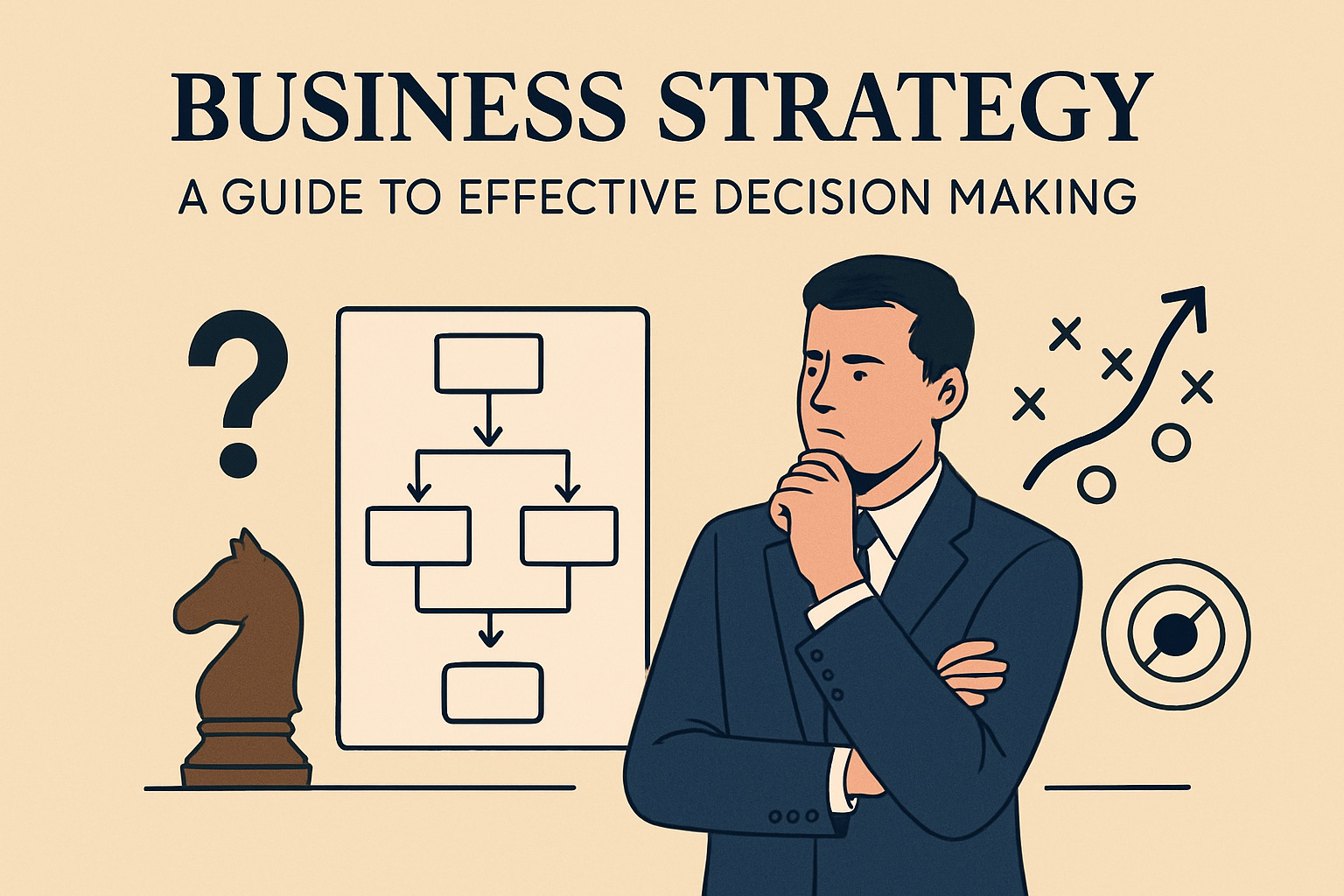
Business strategy a guide to effective decision making isn’t just corporate jargon – it’s the difference between thriving and barely surviving as an entrepreneur.
Key Elements:
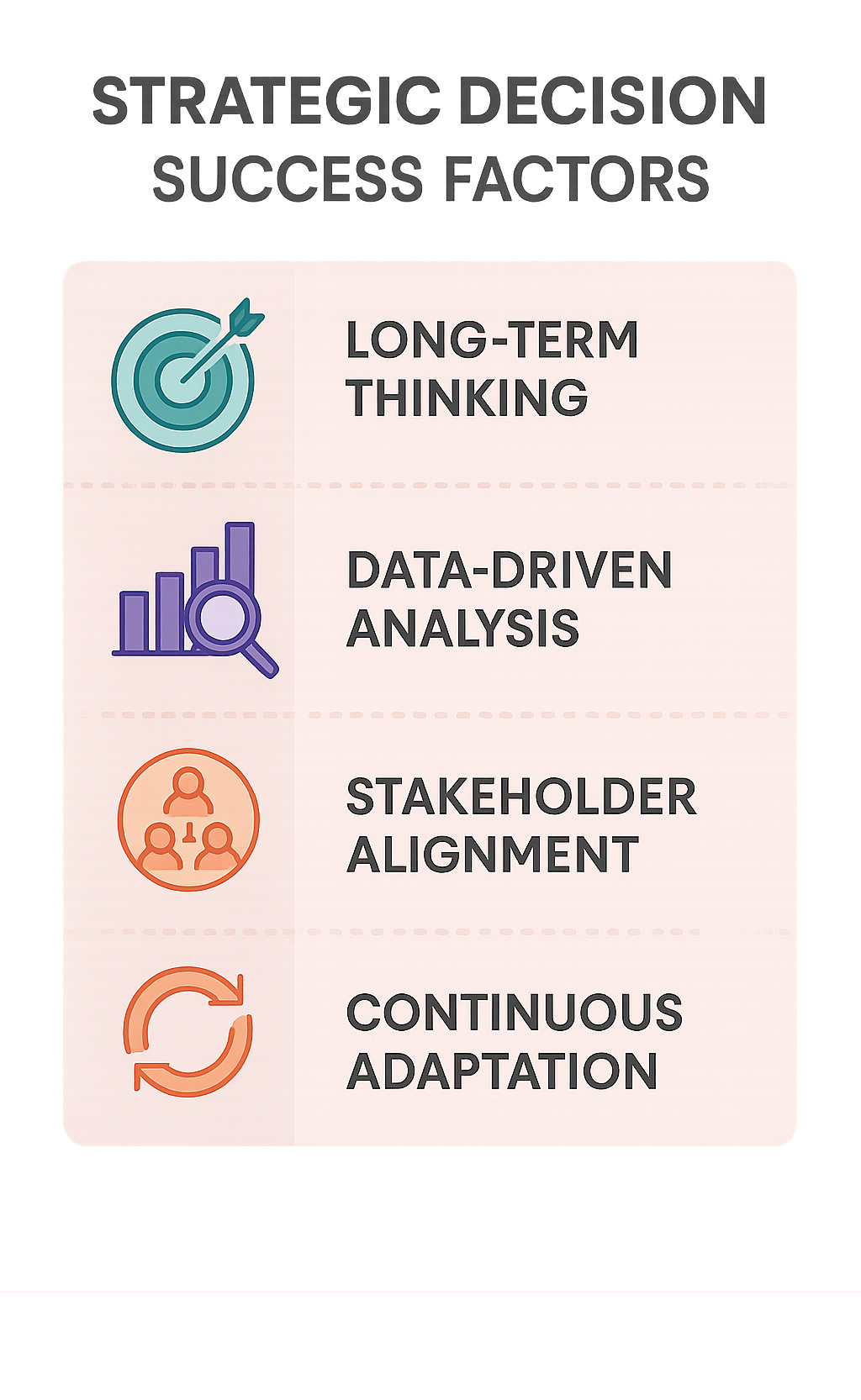
– Long-term focus – decisions that shape your company’s future direction
– Data-driven process – combining analysis with intuition and experience
– Stakeholder alignment – involving the right people in critical choices
– Continuous adaptation – monitoring outcomes and adjusting course
The Strategic Decision Process:
1. Identify the strategic issue
2. Analyze environment and organization
3. Generate multiple alternatives
4. Evaluate options against criteria
5. Implement the chosen strategy
6. Monitor and adjust as needed
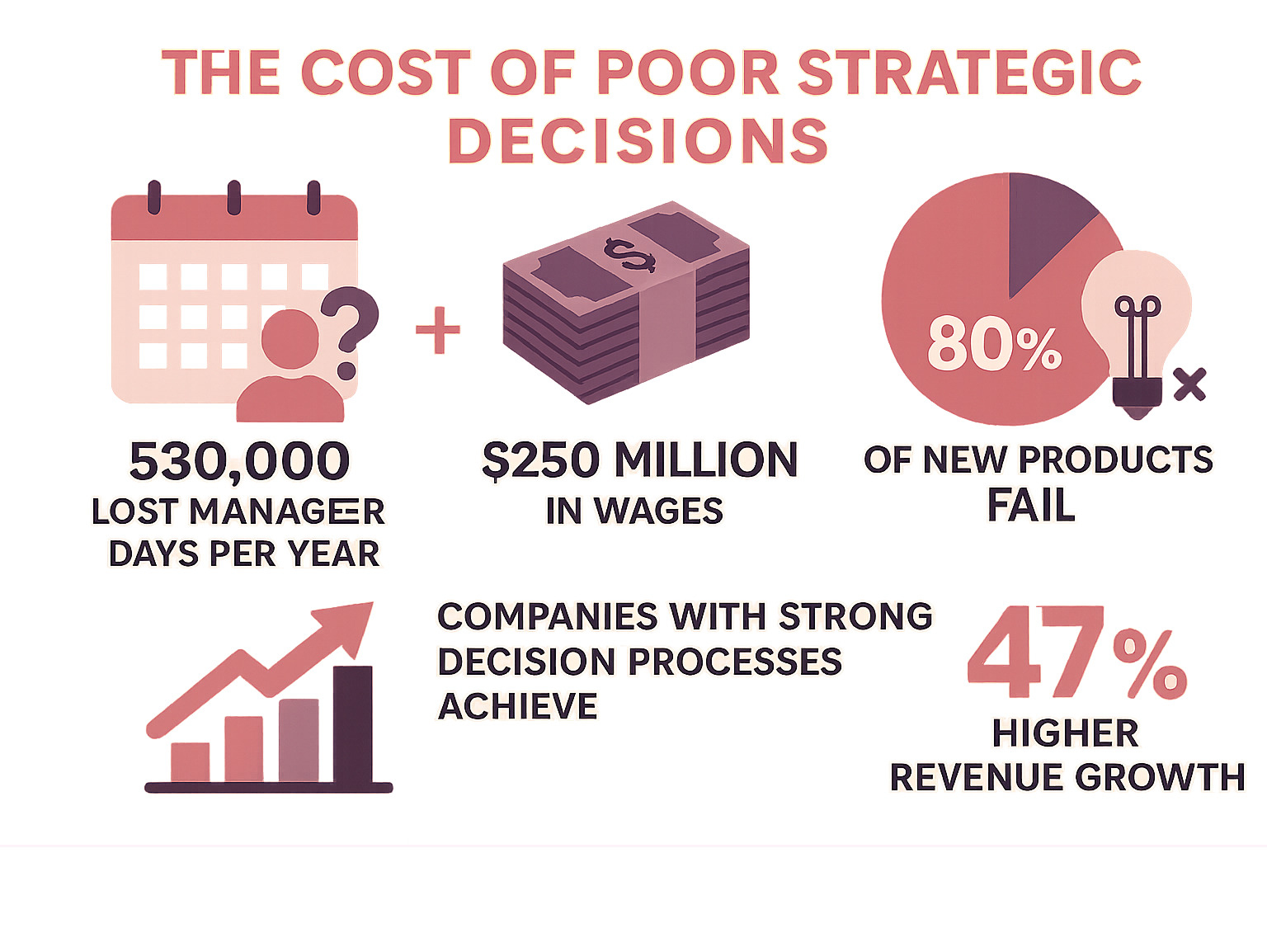
Research shows that inefficient decision making costs Fortune 500 companies 530,000 days of managers’ time annually – equivalent to $250 million in wages. 80% of new products fail due to poor decision making.
The good news: companies with strong decision-making processes achieve 47% higher revenue growth and 36% higher earnings growth than their peers.
For entrepreneurs, mastering strategic decision making determines your venture’s fate – whether you’re pivoting your product, entering new markets, or allocating resources.
Business Strategy: A Guide to Effective Decision Making
Business strategy is your systematic approach to making choices that matter – the ones determining whether you’re building something lasting or just keeping busy.
At its heart, business strategy creates sustainable competitive advantage through deliberate choices. It bridges your current reality to your future vision. Many entrepreneurs think strategy is just about goals, but it’s really about having a reliable process for making tough decisions that shape your company’s destiny.
Your mission and vision aren’t just wall art – they’re your decision-making North Star. When facing difficult choices, ask: “Does this move us closer to our vision while staying true to our mission?”
Understanding strategic versus operational decisions is crucial:
| Strategic Decisions | Operational Decisions |
|---|---|
| Long-term impact (1-5+ years) | Short-term impact (days to months) |
| High resource commitment | Lower resource commitment |
| Difficult to reverse | Easily reversible |
| CEO/senior leadership | Middle management/front-line |
| Market entry, acquisitions | Daily operations, staffing |
Strategic decisions are the big moves that either catapult you ahead or leave you playing catch-up. The secret? Balancing long-term vision with short-term realities.
What does “business strategy a guide to effective decision making” really mean?
Business strategy a guide to effective decision making weaves together three essential elements:
Strategic thinking – looking beyond today’s fires to understand what’s really driving your challenges and opportunities.
Systematic process – following structured approaches rather than just trusting your gut every time.
Value creation – every major decision should contribute to building sustainable competitive advantage.
The beauty lies in consistency. Instead of random decisions based on whoever shouted loudest, you’re building a framework that guides you toward success repeatedly.
How to apply “business strategy a guide to effective decision making” in your startup?

As a startup founder, you don’t have six-month planning cycles, but you do have agility. Use that agility strategically, not just reactively.
Start with a founder mindset shift. Instead of making decisions based purely on urgency, ask: “What are the long-term implications?”
Create simple decision filters based on your mission, vision, and strategic objectives. Build strategic thinking into everyday operations.
For agile pivots, use resources like Business Trend Analysis to understand whether market signals require strategy adjustments or just tactical refinements.
Your size is an advantage – you can implement strategic changes quickly and test effectiveness in real-time.
The Strategic Decision-Making Process End-to-End
Making smart strategic decisions requires a systematic approach that transforms overwhelming challenges into actionable plans – your business strategy a guide to effective decision making playbook.
The difference between successful and struggling businesses often comes down to having a structured decision-making process. This framework addresses the challenge that 80% of executives face – processing too much information when seeking solutions.
This process integrates insights from Business Analysis: Using Data for Making Effective Decisions with methodologies proven in practice, as Strategic Decision Making research demonstrates.
Step 1–3: Diagnose, Analyze, Ideate
Step 1: Diagnose the real issue – most people jump to solutions without understanding what they’re solving. Use the “5 Whys” technique to drill down to root causes.
Step 2: Analyze environment and organization using SWOT analysis (strengths, weaknesses, opportunities, threats) and PESTLE analysis (political, economic, social, technological, legal, environmental factors). Logic trees break complex problems into manageable pieces.
Step 3: Generate multiple options – resist going with your first idea. Research shows organizations considering multiple alternatives make significantly better decisions. Brainstorm at least 3-5 viable options.
Step 4–6: Decide, Execute, Review
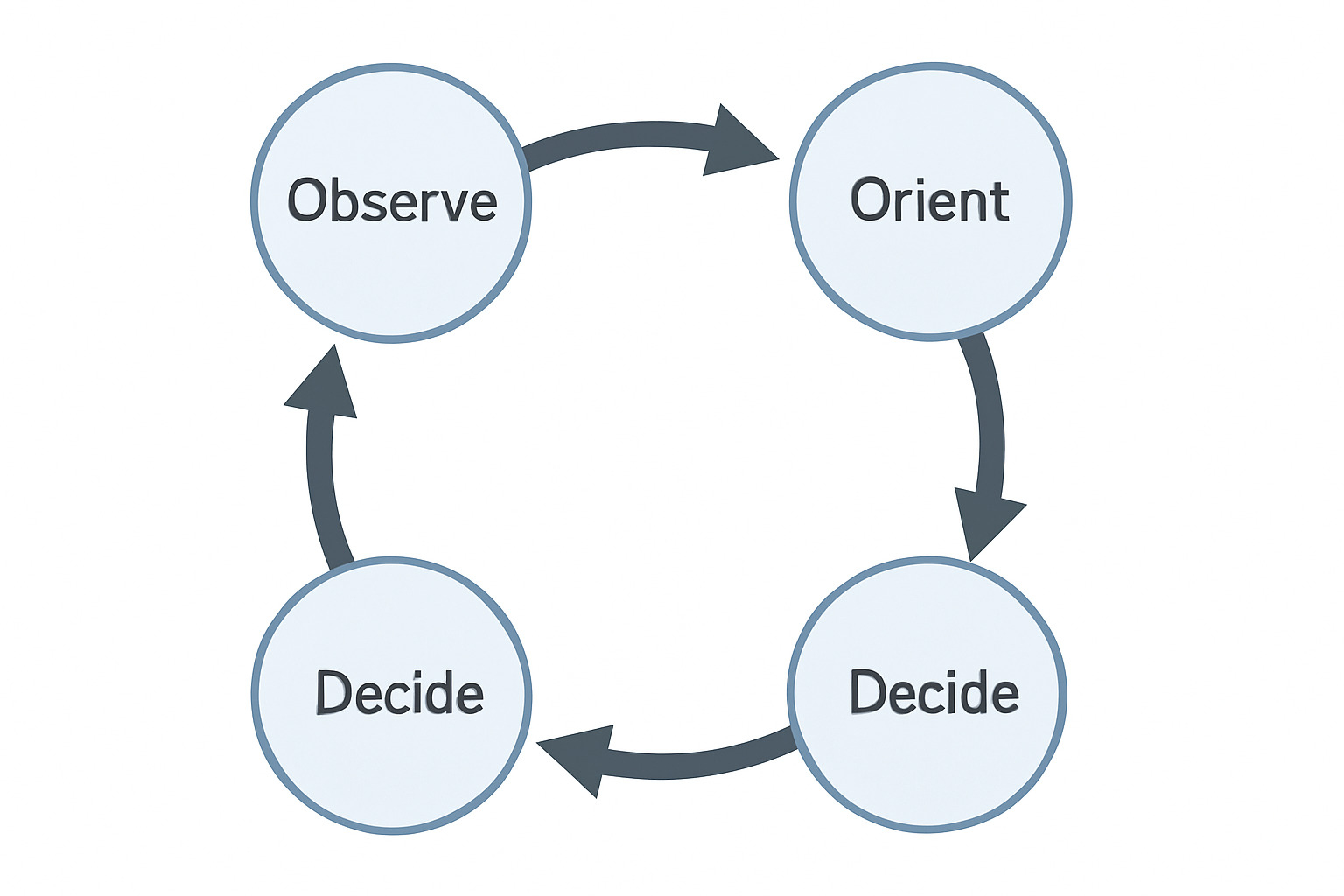
Step 4: Make the decision using structured criteria: alignment with objectives, resource requirements, risk level, implementation time, and ROI. The RAPID framework clarifies roles: Recommend, Agree, Perform, Input, Decide.
Step 5: Execute with excellence – the best decision poorly executed beats a mediocre decision executed perfectly. Create detailed implementation plans with clear timelines, resource allocation, communication strategy, and risk mitigation.
Step 6: Monitor and adjust through feedback loops tracking progress. Set up KPIs, use scenario planning for course corrections. The OODA Loop (Observe, Orient, Decide, Act) provides excellent framework for continuous adaptation.
Strategic decisions aren’t carved in stone. Successful leaders adjust their approach while staying true to strategic intent.
Tools & Frameworks That Sharpen Your Choices
Strategic frameworks are your decision-making toolkit. The right tools transform your business strategy a guide to effective decision making from educated guessing into systematic competitive advantage.
SWOT Analysis – Look for connections between quadrants. How can strengths capitalize on opportunities? Which weaknesses make you vulnerable to threats?
Porter’s Five Forces maps competitive forces: threat of new entrants, bargaining power of suppliers/buyers, threat of substitutes, and competitive rivalry. High-threat environments call for defensive strategies; low-threat situations support aggressive expansion.
Decision Matrix brings objectivity to emotional choices. List criteria, weight by importance, score each option, let math guide you.
Ladder of Inference prevents faulty logic by making your reasoning process visible – from observable facts through assumptions to conclusions.
OODA Loop (Observe, Orient, Decide, Act) emphasizes speed and adaptation over perfect information.
Scenario Planning prepares you for multiple futures. Develop 3-4 plausible scenarios, test how strategies perform under each.
Combine tools strategically: Start with SWOT for analysis, use Porter’s Five Forces for competitive assessment, apply scenario planning for risk evaluation, finish with decision matrix for selection. The Business Budgeting for Beginners guide provides additional frameworks for resource allocation.
As McKinsey insights on decision making emphasize, frameworks are thinking aids, not judgment substitutes. The goal isn’t eliminating uncertainty but making better decisions despite it.
People, Culture & Collaboration in Strategy

The best strategic decisions emerge from teams that collaborate effectively while keeping decision-making crisp and clear.
Cross-functional teams bring diverse perspectives that spot opportunities and risks you might miss. Your marketing person sees customer trends, operations understands capacity constraints, finance knows the numbers.
The secret is balancing diverse input with clear accountability. Everyone should know their role using the RAPID framework. Diversity isn’t just nice to have – it’s strategically essential. Varied backgrounds challenge assumptions and surface blind spots.
Combine data with intuition. Use data to inform intuition and let experience guide you toward the right data to examine.
Governance structures keep things moving. Set clear boundaries – team leads approve expenses under $5,000, but product strategy needs your sign-off.
The Startup Growth Strategies approach emphasizes empowerment within boundaries – give people frameworks for decisions, then trust them to execute.
Overcoming Biases and Pitfalls
Confirmation bias makes us seek information confirming existing beliefs while ignoring contradictory evidence. Anchoring bias gets us stuck on first information heard. Information overload affects nearly half of decision-makers – the solution isn’t more data, but better filtering.
The 5 Hows framework flips problem-solving by asking “how can we fix this?” instead of endlessly asking “why.”
The 10-10-10 Rule provides perspective: How will I feel about this choice in 10 minutes, 10 months, and 10 years?
Risk management means developing contingency plans for likely failure scenarios.
Building a Strategic Culture
Agility means quick decisions without cutting quality corners. Create templates for common decisions, establish clear processes, give people authority within boundaries.
Continuous learning transforms every decision into growth opportunity. Transparent communication means sharing not just what you decided, but why. Ownership means those recommending actions help implement them.
Monitoring, Learning & Adapting in a Turbulent World

Making good decisions is half the battle. The other half is monitoring outcomes and adapting when reality doesn’t match projections.
KPIs and dashboards provide early warning systems. Focus on metrics that predict success for your specific strategy. Leading indicators matter more than lagging ones.
Scenario testing prepares you for multiple futures. Regularly stress-test decisions against different conditions. AI analytics identify patterns humans might miss, but strategic thinking still requires human judgment.
Iterative reviews should be scheduled: monthly for major initiatives, quarterly for overall strategy. Ask hard questions: Are we solving the right problem? Do assumptions still hold?
The Top 7 Marketing Strategies Every New Business Should Use shows monitoring and adaptation in practice.
Real-World Examples & Lessons
Netflix’s Streaming Pivot demonstrates strategic foresight. While competitors optimized DVD delivery, Netflix invested in streaming despite poor quality and high costs, recognizing long-term trends.
Kodak’s Digital Miss shows how past success blinds you to opportunities. They invented digital cameras in 1975 but feared cannibalizing film profits, leading to bankruptcy while competitors captured their market.
Tesla’s Master Plan exemplifies long-term thinking: start with expensive, low-volume cars to fund development, then move to higher-volume, lower-cost vehicles, then add solar and energy storage.
Key insights:
– Strategic decisions require courage to act on imperfect information
– Past success can prevent necessary adaptation
– Best strategies unfold in phases, building capabilities over time
– Digital change requires rethinking entire value propositions
Frequently Asked Questions about Strategic Decision Making
How often should a strategic plan be updated?
Quarterly reviews work best for most businesses – enough time to see results, not so much that you drift off course. Annual updates suffice for major changes unless something dramatic happens. Continuous monitoring is key.
Startups often need monthly check-ins due to rapid learning. Distinguish between strategic adjustments (fundamental direction changes) and tactical tweaks (execution changes).
What’s the difference between tactical and strategic decisions?
Strategic decisions shape your company’s future, are hard to reverse, require significant resources, and affect multiple business areas. Netflix’s shift from DVDs to streaming was strategic.
Tactical decisions support strategy with shorter-term impacts and easier reversibility. Launching specific campaigns or adjusting prices within established ranges are tactical.
When unsure, ask: “If this doesn’t work, how hard would it be to undo?” Strategic decisions are painful to reverse.
How can small businesses get started with strategic frameworks?
Start with three simple questions:
– Where are we now? (honest current situation assessment)
– Where do we want to be? (clear 2-3 year vision)
– How do we get there? (2-3 most critical decisions needed)
Begin with basic SWOT analysis – simple but powerful when done thoughtfully. Focus on the 2-3 most critical decisions facing your business. Small businesses win through speed and adaptation, not perfect planning.
As you grow, gradually add sophisticated tools. The goal is building strategic thinking habits, not mastering every framework.
Conclusion
Business strategy a guide to effective decision making is like learning to ride a bike – real mastery comes from practice. The frameworks provide training wheels, but confidence grows with every strategic choice.
Successful entrepreneurs don’t make perfect decisions every time. They’ve developed reliable processes for tough choices and aren’t afraid to adjust when new information emerges. They make good decisions quickly rather than perfect decisions slowly.
They think systematically, know when to analyze versus trust experience, and treat every decision as a learning opportunity. Strategic decision-making gets easier with practice – each choice builds your strategic muscles.
Combine solid analysis with hard-earned intuition. Bring in different perspectives for better outcomes. Monitoring and adapting are as critical as initial choices. Markets shift constantly – successful companies stay alert and adjust while maintaining strategic vision.
Building strategic thinking throughout your team creates competitive advantage that’s hard to copy. When everyone thinks strategically, you become incredibly agile and responsive.
These core principles serve you well regardless of future changes – new technology, shifting customers, or economic uncertainty. A solid decision-making process gives confidence to steer any challenges.
At TheEntrepreneurs.net, we believe every entrepreneur deserves access to tools that transform their business. These strategic decision-making skills aren’t just for Fortune 500 companies – they’re for anyone building something meaningful.
If you’re starting your entrepreneurial journey, The Ultimate Beginner’s Guide to Starting Your Own Business shows how to apply these principles from day one for long-term success.
The future belongs to leaders who steer complexity with confidence, make tough calls when paths aren’t clear, and pivot quickly when circumstances change. Master strategic decision-making, and you’ll be ready for whatever opportunities and challenges come your way.