

Why Business Intelligence Is Critical for Modern Decision-Making
Effective and timely decisions in business intelligence are the difference between thriving and merely surviving in today’s business world. Here’s what you need to know:
Key Components of Effective BI Decision-Making:
- Data Quality: Clean, accurate, and relevant information
- Speed: Real-time or near-real-time insights
- Accessibility: Easy-to-understand dashboards and reports
- Action-Oriented: Clear recommendations, not just data dumps
- Human + AI: Combining analytical insights with business expertise
The stakes couldn’t be higher. Research shows that 89% of senior leaders believe slow decisions risk being left behind by competitors. The average S&P 500 company wastes approximately $250 million per year due to ineffective decision-making.
Despite this urgency, 67% of executives feel uncomfortable accessing or using data from their tools, while only 25% of decision-makers make choices primarily based on data. This gap represents both a massive challenge and an enormous opportunity for competitive advantage.
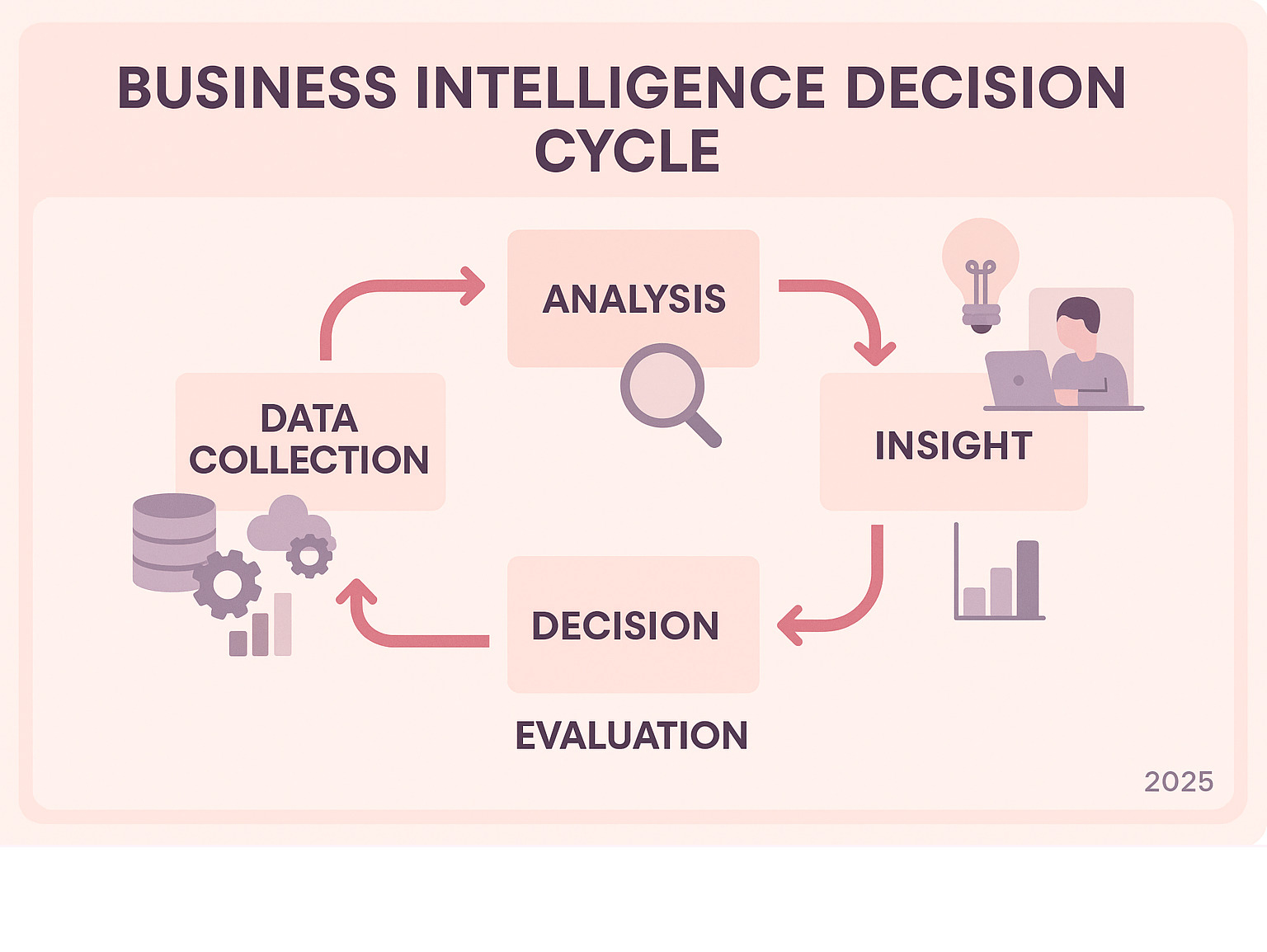
Quick look at effective and timely decisions in business intelligence:
- business analysis using data for making effective decisions
- business strategy a guide to effective decision making
Understanding Effective and Timely Decisions in Business Intelligence
Business intelligence (BI) uses data, technology, and analysis to help you see what’s happening in your business and what you should do about it. But what makes effective and timely decisions in business intelligence so special?
An effective decision is built on solid, accurate data that matters to your business. It considers the bigger picture, aligns with your company goals, and delivers measurable results.
A timely decision is made quickly enough to grab opportunities before they slip away and catch problems before they become expensive disasters.
When these qualities combine, businesses making decisions 30% faster than competitors enjoy 16% higher profit growth on average.
Data, Information, Knowledge: The Building Blocks
Raw data is your starting point—crude oil costs $80 per barrel today.
Processed information adds context—crude oil jumped from $70 to $80 per barrel over the past month.
Applied knowledge drives decisions—this 14% increase will impact your logistics company’s fuel costs and delivery pricing.
This change is where BI systems earn their keep, connecting dots and presenting insights that enable confident, quick decisions.
Why “Effective and Timely Decisions in Business Intelligence” Matter
The financial impact is measurable. Companies with better data access made 82% more customer-oriented decisions during 2020, translating directly into stronger financial performance.
Competitive advantage comes from spotting trends first and acting fastest. Risk management improves when you can catch problems early.
The flip side: 71% of executives regretted decisions made too slowly, with 35% seeing operational efficiency drop and 34% experiencing reduced employee engagement.
Human Judgment + BI: Striking the Balance
The goal isn’t to replace human judgment but augment it. Human strengths include understanding context, applying ethics, and building stakeholder buy-in. BI strengths include processing vast data, spotting patterns, and providing consistent analysis.
The sweet spot is “augmented analytics”—using BI to boost human decision-making. While 79% of leaders still make decisions based on instinct, they make better instinct-based decisions with comprehensive, timely data.
BI Architecture & Components for Decision Excellence
Building effective BI is like constructing a house—you need solid foundations and the right components working together.
Data sources provide the foundation: internal systems (CRM, ERP), external sources (market data, social media), real-time streams (IoT sensors, web analytics), and third-party datasets.
ETL processes (Extract, Transform, Load) clean and standardize messy data before analysis. Data warehouses serve as central repositories, while data marts focus on specific business areas.
Analytics and reporting tools transform stored information into actionable insights through dashboards, reports, and predictive models.
| Passive BI | Active BI |
|---|---|
| Hypothesis-driven | Pattern finding |
| Query and reporting | Data mining |
| User-initiated | System-initiated |
| Answers specific questions | Finds unknown patterns |
Passive BI answers your questions. Active BI acts like a detective, finding patterns and alerting you to opportunities you didn’t know to look for.
Ensuring Data Quality, Relevance & Timeliness
Data governance establishes trust through clear ownership, quality standards, and security protocols. Data cleansing removes duplicates, corrects errors, and standardizes formats.
Creating a single source of truth eliminates conflicting reports. KPI definition focuses attention on metrics that directly relate to business outcomes.
For detailed guidance, see Business Analysis: Using Data for Making Effective Decisions.
Tools That Accelerate Effective and Timely Decisions in Business Intelligence

Data visualization tools like Tableau and Power BI create dashboards that reveal insights within three seconds—the “3-second rule.”
Self-service BI platforms eliminate bottlenecks by letting business users explore data themselves. Mobile dashboards enable decision-making anywhere, anytime.
Real-time analytics provides immediate insights for immediate response. Alerting systems notify the right people about critical issues instantly.
GIS and spatial analytics add geographic context that reveals hidden patterns in your data.
Mathematical Models & Analytics: From Insight to Action
Advanced analytics predict what might happen and recommend actions. What-if scenarios let you test strategies before committing resources. Optimization models find the best solutions among alternatives.
Prescriptive analytics suggests what you should do, while decision trees and neural networks provide sophisticated pattern recognition for complex situations.
Overcoming Challenges & Ethical Considerations
Implementing effective and timely decisions in business intelligence faces real obstacles that can derail efforts.
Executive discomfort with data remains a major roadblock. Many leaders feel uneasy accessing or interpreting BI systems, often due to lack of training, overwhelming dashboards, or past experiences with inaccurate data.
Data silos create fragmented views when sales data lives in CRM, financial information sits in ERP, and marketing data exists separately. Change management requires cultural shifts beyond technical implementation.
A sobering statistic: more than half of all standard reports in organizations aren’t being used by anyone. Organizations focus on generating information rather than ensuring it’s useful for decision-making.
For insights on this challenge, see How Fast and Flexible Do You Want Your Information, Really?.
Common Pitfalls Blocking Effective and Timely Decisions in Business Intelligence
Overestimating data readiness: Only 50% of executives rate their ability to deliver timely, accurate data as high. Conduct honest assessments and focus on incremental improvements.
Using unhealthy data: Poor data quality undermines sophisticated tools. Treat data quality like a health program with prevention, treatment, and monitoring.
Focusing on vanity metrics: Track numbers that drive business outcomes, not impressive-looking metrics that don’t matter.
The time-to-insight myth: The goal isn’t faster insights—it’s faster, better decisions.
Safeguarding Trust: Governance, Security & Ethics
Data privacy and compliance with regulations like GDPR and CCPA are business-critical requirements. Build privacy considerations into BI systems from the ground up.
Algorithm transparency ensures stakeholders understand how automated decisions are made. Bias detection and mitigation requires diverse teams and regular auditing.
Security measures protect sensitive information through encryption, access controls, and incident response plans. A security breach can destroy the trust that makes BI systems effective.
Best Practices & Strategic Roadmap to Accelerate Decision-Making
Creating effective and timely decisions in business intelligence requires a strategic approach combining people, processes, and technology.
Step 1: Verify the Need for Change
Identify which decisions are made too slowly and where lack of information causes missed opportunities.
Step 2: Quantify Stakeholder Objectives
Set specific, measurable goals like “increase revenue by 20%” or “reduce costs by 15%.”
Step 3: Dedicate Cross-Functional Resources
Combine IT technical expertise with business domain knowledge.
Step 4: Determine Key Performance Indicators
Focus on KPIs that trigger action when they change.
Step 5: Select the Right Tools
Evaluate based on integration, scalability, ease of use, and total cost of ownership.
Step 6: Implement Data Cleaning
Establish validation rules and ongoing monitoring processes.
Step 7: Pursue Phased Rollout
Start with pilot projects to prove value before expanding.
Step 8: Measure and Refine
Continuously monitor impact and make adjustments.
For strategic guidance, see Business Strategy: A Guide to Effective Decision Making.
Implementing Decision Intelligence for More Effective and Timely Decisions in Business Intelligence
Decision Intelligence combines analytics, automation, and AI to recommend what should happen next. While BI shows where you’ve been, DI acts like GPS—showing where you are and recommending the best route forward.
Analytics plus automation means systems don’t just present data—they automate routine decisions. AI augmentation continuously improves through machine learning. Learning loops capture decision results to improve future recommendations.
Fostering a Data-Driven Culture
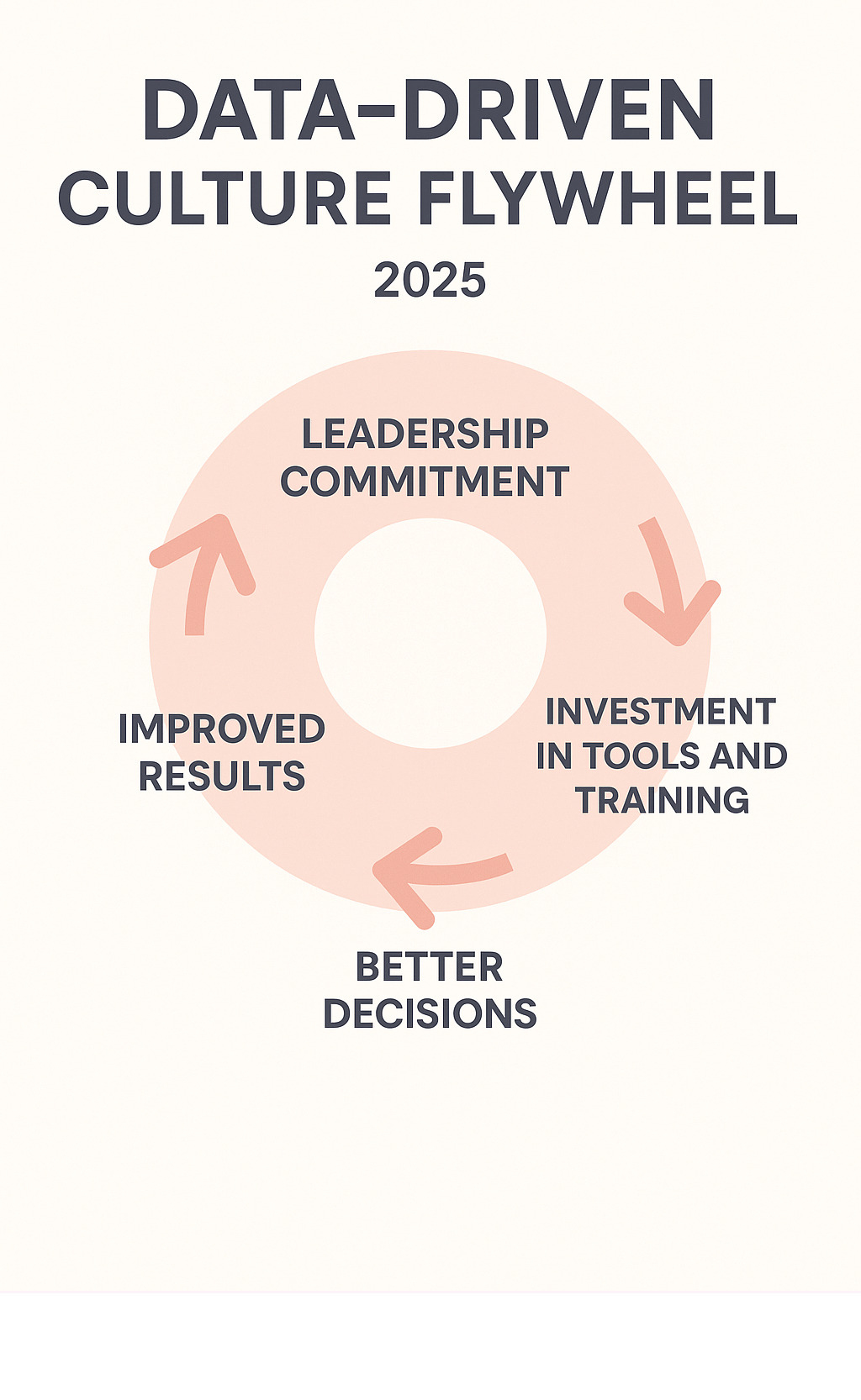
Technology alone isn’t enough—you need culture that values data in decision-making.
Leadership buy-in is essential. When executives consistently use data and communicate its importance, it signals organizational priorities.
Data literacy training ensures employees can interpret and use data effectively. Self-service capabilities empower employees to explore data independently.
Collaboration and sharing break down silos. Recognition programs celebrate successful data-driven decisions and share success stories.
Case Studies: Real-World Impact of BI on Timely Decisions
Real examples demonstrate how organizations achieve effective and timely decisions in business intelligence:
Ukrainian Fashion Retailer Success Story
Replaced spreadsheet reporting with interactive dashboards. The CFO could see key metrics within seconds instead of spending hours on manual reports. Result: 32% increase in gross margin by quickly identifying and responding to customer preference trends.
Manufacturing Quality Control
Implemented real-time monitoring to identify production issues as they occurred rather than after the fact. This proactive approach reduced waste, improved customer satisfaction, and saved millions in potential recalls.
Financial Fraud Detection
Deployed machine learning to analyze transaction patterns in real-time, identifying fraudulent transactions within milliseconds. Reduced fraud losses by 40% while minimizing false positives.
GIS-Improved Decision Making
Used spatial visualization to optimize delivery routes and warehouse locations. Visual approach made complex logistics decisions intuitive, leading to 15% reduction in delivery costs.
Quantifiable Outcomes of Effective and Timely Decisions in Business Intelligence
Speed Improvements: 30% faster decision-making with some routine decisions fully automated.
Cost Savings: 15-20% reduction in operational costs through better resource allocation.
Revenue Growth: 16% higher profit growth compared to competitors.
Customer Satisfaction: 10-15% improvement through faster response to issues.
Employee Engagement: Measurable increases when employees have access to decision-making data.
Frequently Asked Questions about Effective and Timely Decisions in Business Intelligence
What’s the difference between BI and decision intelligence?
Business Intelligence analyzes historical data to understand what happened and why—like a rearview mirror showing sales trends and campaign performance.
Decision Intelligence adds predictive and prescriptive capabilities—like GPS with real-time updates. It predicts what might happen and recommends actions.
Example: BI shows inventory dropping faster than usual. DI predicts when you’ll run out, recommends optimal reorder quantities, and can automatically place orders.
The key difference: DI combines analytics with automation and AI to actively support decision-making, not just provide information.
How do we measure the ROI of faster decisions?
Start with baseline measurements before implementing BI improvements—track decision time, costs, and outcomes.
Direct benefits include reduced costs from better resource allocation and increased revenue from faster opportunity response.
Avoided losses come from identifying and addressing problems quickly before they become expensive.
Indirect benefits include improved employee productivity, better customer satisfaction, and stronger competitive positioning.
Most organizations see ROI within 6-12 months, tracking time savings, cost reductions, and revenue increases.
Can small businesses afford advanced BI tools?
Yes—the BI landscape has changed dramatically. Cloud-based solutions offer pay-as-you-go pricing accessible to all business sizes.
Start small and grow gradually with free tiers or low-cost starter plans. Focus on biggest pain points first—solve critical decisions before expanding.
Consider the cost of NOT having BI—poor decision-making often costs more than BI tools. Cloud-based solutions eliminate technical barriers and can be set up in hours.
Match your BI investment to your business stage, focusing on decisions that directly impact your bottom line.
Conclusion
The ability to make smart decisions quickly isn’t just nice to have—it’s essential for survival in today’s business world.
You don’t need to transform everything overnight. Start small with clear objectives—a simple dashboard, automated routine decisions, or improved data quality in one critical area.
Data quality remains the foundation of everything else. No analytics can compensate for poor data. Culture change takes time but creates compounding value when teams naturally ask “what does the data say?”
The investment in better decision-making creates advantages that accumulate over time. Your ability to spot trends early, respond quickly, and capitalize on opportunities builds lasting competitive advantage.
This is an ongoing journey of continuous refinement. As your business grows, your BI capabilities should evolve alongside it.
Ready to take the next step? Explore our comprehensive resources: More info about business automation.
The future belongs to organizations that can consistently make effective, timely decisions. With the right approach, tools, and commitment, yours can be one of them.