

Why Real Estate is a Cornerstone of Wealth
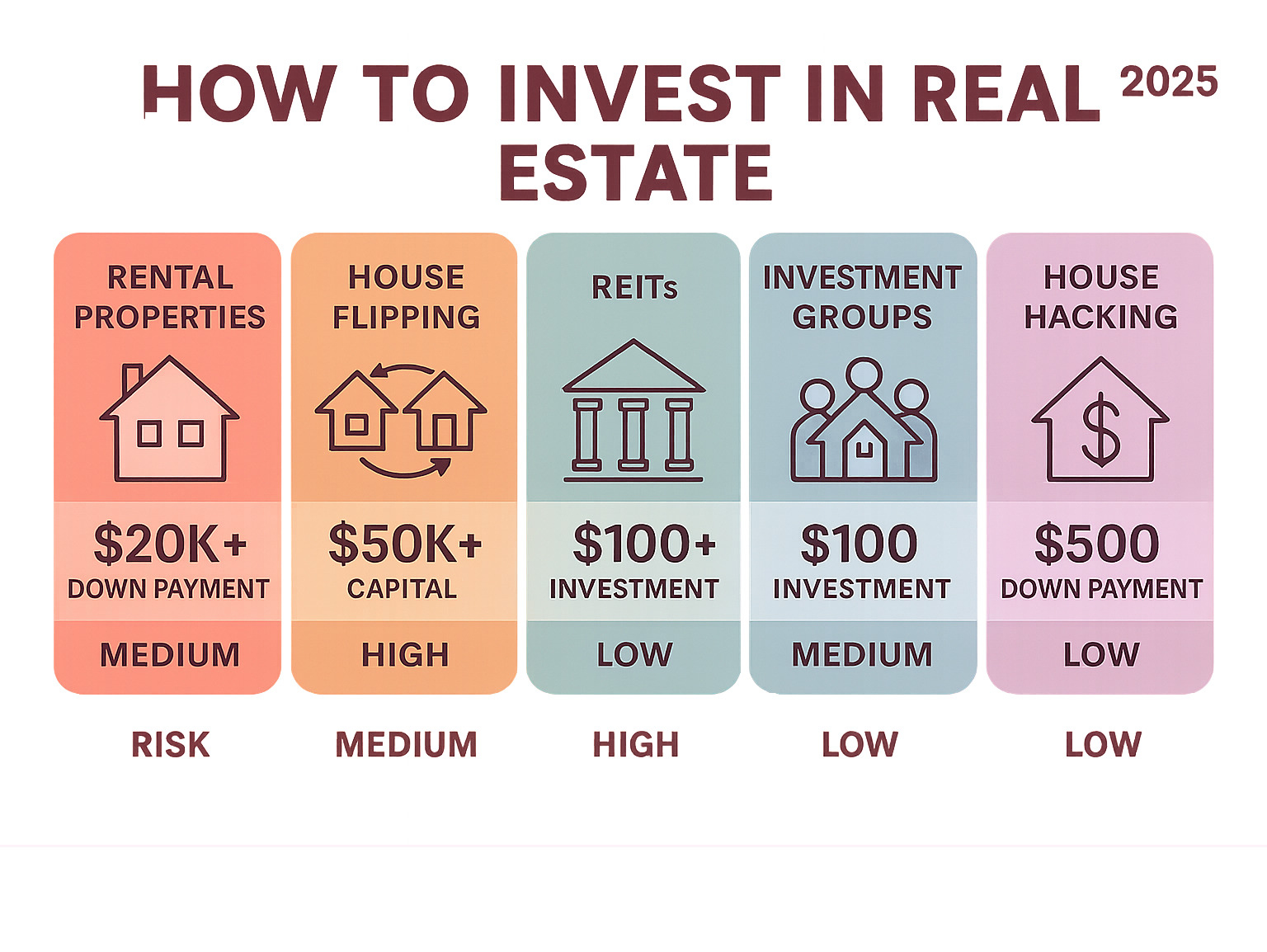
How to invest in real estate involves choosing a method that fits your capital, time, and risk tolerance. The five main paths are rental properties, house flipping, Real Estate Investment Trusts (REITs), investment groups, and house hacking.
Quick Answer – Main Ways to Invest in Real Estate:
- Rental Properties – Buy and rent out homes for monthly cash flow.
- House Flipping – Buy, renovate, and sell properties for profit.
- REITs – Purchase shares in real estate companies through the stock market.
- Investment Groups – Pool money with other investors for larger deals.
- House Hacking – Live in part of a property while renting out the rest.
Real estate is a proven path to financial freedom, with 90% of the world’s millionaires having created wealth through real estate. For busy entrepreneurs, it offers a way to generate passive income that builds wealth while you focus on your business.
As the world’s largest asset class, valued at over $230 trillion, real estate is a significant component of wealth. The good news for entrepreneurs is that you can start with surprisingly little money—some methods require as little as $500.
This guide will show you how to choose the right strategy, avoid common mistakes, and build a real estate portfolio that creates lasting wealth.
The Foundation: Benefits and Risks of Real Estate Investing

Before diving into how to invest in real estate, it’s crucial to understand both its advantages and its challenges. While real estate is widely considered a safe long-term investment, it’s not a get-rich-quick scheme. Success depends on understanding the full picture.
The Upside: Key Advantages
Real estate’s popularity is built on several compelling benefits:
- Appreciation: Property values tend to grow over time, building your net worth. Historically, home prices have shown significant long-term growth.
- Cash Flow: Rental properties can provide a steady stream of income when your rental earnings exceed expenses like your mortgage, taxes, and maintenance.
- Tax Advantages: Investors can deduct mortgage interest, property taxes, and operating expenses. Depreciation allows you to get a tax deduction on your property’s value, even as it appreciates.
- Leverage: You can use borrowed capital (a mortgage) to purchase a large asset with a relatively small down payment, amplifying your potential returns.
- Control: Unlike stocks, you have direct control over your real estate asset, from making improvements to choosing tenants.
- Hedge Against Inflation: As the cost of living increases, so do property values and rental rates, which helps protect your purchasing power.
The Downside: Potential Challenges
Be prepared for these potential problems:
- Lack of Liquidity: Real estate is an illiquid asset. Selling a property can take months, so you can’t access your cash quickly.
- High Initial Capital: Buying property requires a significant upfront investment for the down payment, closing costs, and cash reserves.
- Time Commitment: Being a landlord or house flipper is an active role that requires time for management, maintenance, and tenant communication.
- Unexpected Expenses: A new roof, a broken furnace, or a period of vacancy can arise unexpectedly and eat into your profits.
- Tenant Issues: Dealing with late rent, property damage, or evictions can be stressful and costly.
- Market Risk: Economic downturns, rising interest rates, or local market shifts can negatively impact property values and rental demand.
The Blueprint: 5 Core Ways to Invest in Real Estate
The beauty of real estate investing is its flexibility. You can choose a strategy that matches your financial goals, available time, and risk tolerance. Some methods are completely passive, while others require hands-on involvement. Understanding what each approach demands—and what it can deliver—is the key to making the right choice.
Here’s how the five core real estate investment methods compare:
| Investment Method | Minimum Capital | Time Commitment | Risk Level | Liquidity |
|---|---|---|---|---|
| Rental Properties | $20,000+ | High | Medium-High | Low |
| House Flipping | $50,000+ | High | High | Medium |
| Real Estate Investment Trusts (REITs) | $10 – $1,000 | Low | Low | High |
| Real Estate Investment Groups | $1,000+ | Medium | Medium | Low |
| House Hacking | $5,000+ | Medium-High | Low-Medium | Low |
- Rental properties are the classic strategy for building wealth through monthly cash flow and long-term appreciation.
- House flipping is for those seeking faster profits through buying, renovating, and quickly reselling properties.
- REITs offer the easiest, most passive entry point, allowing you to buy shares in real estate companies just like stocks.
- Investment groups let you pool money with others to access larger deals you couldn’t afford alone.
- House hacking is a beginner-friendly strategy where you live in a property while renting out other parts of it to reduce or eliminate your housing costs.
Many successful investors start with one method and expand into others as their capital and knowledge grow. For a deeper dive into overall investment concepts, check out A Guide To Real Estate Investing.
1. Buying Rental Properties

Buying rental properties is the quintessential real estate investment strategy: you buy a property, find tenants, and collect rent. You can opt for long-term rentals for steady income or short-term vacation rentals for potentially higher, though more variable, returns.
The primary benefits are steady cash flow from rent, long-term property appreciation, and tenants paying down your mortgage, which builds your equity. You also gain significant tax advantages, including deductions for mortgage interest, property taxes, and depreciation.
However, being a landlord requires work. You are responsible for tenant screening, property management, and inevitable maintenance costs. You can hire a property manager for 6%-11% of gross rents, but this will reduce your cash flow. The upfront costs are also substantial, typically requiring a 20-30% down payment plus closing costs and reserves.
Steps to Buying a Rental Property
In any market, a disciplined approach is key. With current 30-year mortgage rates at 6.82% APY (as of March 2025), focusing on cash flow is more important than ever.
- Define Your Strategy: Prioritize cash flow, appreciation, or tax benefits.
- Choose Your Market: Look for areas with strong job growth and population trends.
- Set Buying Criteria: Use rules like the 1% rule (monthly rent should be 1% of the purchase price) to quickly vet deals.
- Find Deals: Partner with investor-friendly agents and join local investment groups.
- Analyze Conservatively: Run the numbers to account for all expenses, including vacancies and future repairs.
- Perform Due Diligence: Thoroughly inspect the property, verify financials, and understand local landlord-tenant laws before closing.
2. House Flipping
House flipping is a short-term, active strategy: buy an undervalued property, renovate it, and sell it quickly for a profit. It’s often portrayed as glamorous on TV, but in reality, it’s a hands-on business venture that’s a bit harder than it looks.
The process involves acquisition (finding a distressed property), renovation (managing contractors, budgets, and timelines), and a quick sale to maximize profit and minimize holding costs.
The Upside: Why People Get Hooked
The main appeal is short-term profit realization. A successful flip can generate a significant profit in just a few months. The average gross profit for a flipped house in 2020 was $62,300, and a typical project takes 3 to 6 months.
The Reality Check: Challenges and Risks
House flipping is high-risk. Market shifts can erase profits, and unexpected renovation costs are common. The longer you hold the property, the more you pay in holding costs (mortgage, taxes, insurance), which eats into your bottom line. Profits are also subject to capital gains tax, often at higher short-term rates.
To succeed, you must be highly selective. The 100:10:3:1 rule is a good guideline: for every 100 properties you look at, you might analyze 10, make offers on 3, and successfully purchase 1 profitable deal. This highlights the discipline required to find the right property.
3. Real Estate Investment Trusts (REITs)
If you want to invest in real estate without dealing with tenants or toilets, Real Estate Investment Trusts (REITs) are an excellent option. They are companies that own and operate income-producing real estate, such as office buildings, shopping centers, and apartment complexes.
How REITs Actually Work
REITs collect rent from their properties and are legally required to distribute at least 90% of their taxable income to shareholders as dividends. This structure allows you to earn regular income and lets the REIT avoid corporate income tax.
There are two main types:
- Publicly traded REITs: These trade on major stock exchanges, making them highly liquid and transparent. You can buy and sell them easily through a standard brokerage account. This is the recommended type for most investors.
- Non-traded REITs: These are illiquid and often come with high upfront fees (sometimes 9-10%), which can significantly reduce your returns.
Why REITs Make Sense for Busy Entrepreneurs
REITs offer diversification across many properties and locations, liquidity to access your cash quickly, and truly passive income with professional management. You get exposure to large-scale commercial real estate without the high capital or time commitment of direct ownership.
Important Things to Keep in Mind
REIT dividends are typically taxed as ordinary income, which may be a higher rate than other investment dividends. Also, because they are publicly traded, their value can be sensitive to stock market fluctuations and changes in interest rates.
For entrepreneurs looking to diversify beyond real estate, you might find valuable insights in our Money & Crypto section.
4. Real Estate Investment Groups and Partnerships
Real estate investment groups allow you to pool your resources with other investors to buy into larger deals, like apartment complexes or commercial buildings, that would be unaffordable on your own. This is often done through crowdfunding platforms or private syndications.
How They Work:
Online crowdfunding platforms connect investors with real estate projects, allowing you to start with as little as $500 to $1,000. Syndications are similar but are typically led by a professional (a “syndicator”) who finds and manages the deal, while you act as a passive investor.
The Sweet Advantages:
This approach offers lower capital requirements and instant diversification across multiple projects. You gain access to larger deals and benefit from professional expertise and shared management responsibilities, making it a truly passive investment.
The Reality Check:
There are trade-offs. Illiquidity is the biggest factor; your money is typically tied up for several years until the project is sold. You also need to account for platform fees, which are usually around 1% annually. Finally, performing due diligence on the platform, the deal, and the management team is crucial, as you are trusting others with your capital.
5. House Hacking
House hacking is one of the smartest ways for a beginner to how to invest in real estate. The strategy is simple: you live in a property you own while renting out other parts of it, letting your tenants’ rent payments cover some or all of your mortgage.
How it Works:
You can either buy a single-family home and rent out extra rooms to roommates, or you can buy a multi-family property (like a duplex or triplex), live in one unit, and rent out the others. The multi-family approach is often considered the “gold standard” because you can still qualify for owner-occupied loans with low down payments (as little as 3-5%).
Benefits:
The main advantage is drastically reduced living expenses. It’s also a great entry-level strategy due to favorable financing options. You gain invaluable landlord experience while living on-site and build equity as your tenants help pay down your mortgage.
Challenges:
Of course, living with tenants requires the right personality and clear boundaries. Tenant vetting is even more critical when you’re sharing your home. You must also research and comply with local laws regarding renting rooms, subleasing, and zoning.
House hacking is a powerful strategy that lets you enter the real estate market while minimizing your personal housing costs, setting a strong foundation for future investments.
How to Invest in Real Estate: Your 6-Step Action Plan

Knowing how to invest in real estate is simpler with a clear roadmap. These six steps will guide you from beginner to confident investor. You don’t need to be a millionaire to start; you just need a solid plan. For help preparing your finances, see our guide on Business Budgeting For Beginners.
Step 1: Define Your Financial Goals and Strategy
Start with your “why.” Are you seeking monthly cash flow, long-term appreciation, or tax advantages? Your goals, along with your risk tolerance, time horizon, and available capital, will determine the best strategy for you. Decide if you want a hands-on, active role (like flipping) or a passive one (like REITs). For help with strategic thinking, check out Business Strategy A Guide To Effective Decision Making.
Step 2: Educate Yourself Continuously
Knowledge minimizes risk. Learn the language of real estate (cash flow, cap rate, etc.) and stay current on market trends. Master the specifics of your chosen strategy, whether it’s landlord-tenant laws for rentals or market analysis for REITs. Use resources like industry websites, books, podcasts, and local real estate investment clubs to expand your understanding.
Step 3: Conduct Thorough Market Research
Location is everything. Research areas with strong local economic trends, such as job and population growth. Analyze property values and rental market dynamics, including median rents and vacancy rates. Dig into neighborhood analysis by looking at school districts, crime rates, and future development plans. Understanding local laws and regulations is also critical. For more on data-driven decisions, explore Business Analysis Using Data For Making Effective Decisions.
Step 4: Secure Your Financing
Your financing determines what deals you can pursue. Get pre-approved for a traditional mortgage early on; expect to put 10-20% down for a rental. For house hacking, you can use owner-occupied financing like an FHA loan with as little as 3.5% down. Other options include hard money lenders for flips, using home equity from an existing property, or creative financing like seller financing. Our guide on Startup Funding Options offers more ideas.
Step 5: Assemble Your Professional Team
Real estate is a team sport. You’ll need an investor-friendly real estate agent, a knowledgeable mortgage broker, a protective real estate attorney, and a thorough home inspector. An accountant can help with tax strategy, while reliable contractors are essential for renovations. For a passive approach, a good property manager is key.
Step 6: Find a Deal and Do Your Due Diligence
Now it’s time to act. Develop consistent deal flow through your agent, networking, or direct marketing. When you find a potential property, perform a detailed property analysis, calculating your potential ROI and cash-on-cash return using conservative numbers. Once your offer is accepted, conduct rigorous due diligence. This includes a professional home inspection, reviewing all financial documents (rent rolls, utility bills), verifying the title is clear, and understanding all local laws. Never skip this step—it protects you from costly surprises.
Frequently Asked Questions about How to Invest in Real Estate
How much money do you need to start investing in real estate?
The capital required depends entirely on your chosen method. You can start investing in REITs or crowdfunding platforms with as little as $10 to $1,000. House hacking is another low-cost entry point, as you can use residential loans with down payments as low as 3-5%. Real estate investment groups typically require $1,000 to $25,000. Traditional rental properties and house flipping demand the most capital, usually a 10% to 30% down payment plus reserves for closing costs and repairs.
What is the safest way to invest in real estate for a beginner?
For beginners prioritizing safety and simplicity, publicly traded REITs are an excellent choice. They offer high liquidity, instant diversification, and require no management from you. House hacking is the safest entry into direct property ownership. By living in your investment, you reduce or eliminate your personal housing costs, creating a financial safety net while you gain valuable landlord experience.
What are the main tax benefits of real estate investing?
Real estate offers powerful tax advantages. Key benefits include:
- Depreciation: You can deduct a portion of your rental property’s value from your taxable income each year, even if the property’s market value is increasing.
- Deductions: Mortgage interest, property taxes, and operating expenses on investment properties are deductible.
- 1031 Exchanges: This IRS rule allows you to defer paying capital gains taxes when you sell an investment property by reinvesting the proceeds into a similar property. Be sure to review the latest IRS guidelines or consult with a qualified tax advisor to understand the requirements and timelines.
- Tax-Free Gains on Primary Residence: You can exclude up to $250,000 (or $500,000 for married couples) in capital gains from the sale of your primary home if you’ve lived there for two of the last five years.
Always consult a qualified tax advisor to tailor these strategies to your specific situation.
Conclusion: Building Your Real Estate Legacy
Your how to invest in real estate journey is the start of building a lasting legacy. The key is to match a strategy—whether it’s passive REITs, hands-on rentals, or something in between—to your goals, resources, and personality.
Success in real estate requires a long-term perspective. The 90% of millionaires who built wealth this way did so with patience and persistence, not overnight. They started small, learned from their mistakes, and stayed the course through market fluctuations.
Continuous learning is non-negotiable. The market evolves, so stay curious and informed. Start small with a manageable investment, build your confidence, and let your portfolio grow over time.
At The Entrepreneurs, we’re here to support your wealth-building journey. Taking that first step—whether it’s researching a REIT or analyzing a local rental—is the most important one you can make. Your future self will thank you.
Explore our complete Resource Guides to continue your learning journey.