

Introduction: Why Your Small Business Needs a Tech Upgrade
Tech tools for small businesses are software and services that help you manage and grow your company. They automate tasks, boost productivity, and streamline daily work.
What are tech tools for small businesses?
- Software and services designed to help run your business more effectively.
- They automate tasks, increase productivity, and streamline operations.
Why are they important for small businesses?
- Efficiency: 94% of small business owners say technology helps them run their businesses more efficiently.
- Growth: Businesses using digital tools earn more revenue per employee and grow faster.
- Productivity: They save valuable time by automating repetitive tasks.
Imagine your workday. You check email, review sales, and confirm meetings. A coworker pings you, and you jump on a quick call. You just used four business tools, and your day has barely begun.
This isn’t just a scene from a workday. It’s how modern small businesses operate. Technology isn’t a luxury anymore. It’s a must-have.
Small business owners today use at least one tech platform to run their businesses. Many say these tools helped them start and grow. They are essential for staying competitive. They help you save time, cut down on errors, and boost your bottom line.
Using the right tools means you can focus on what matters most: growing your business.
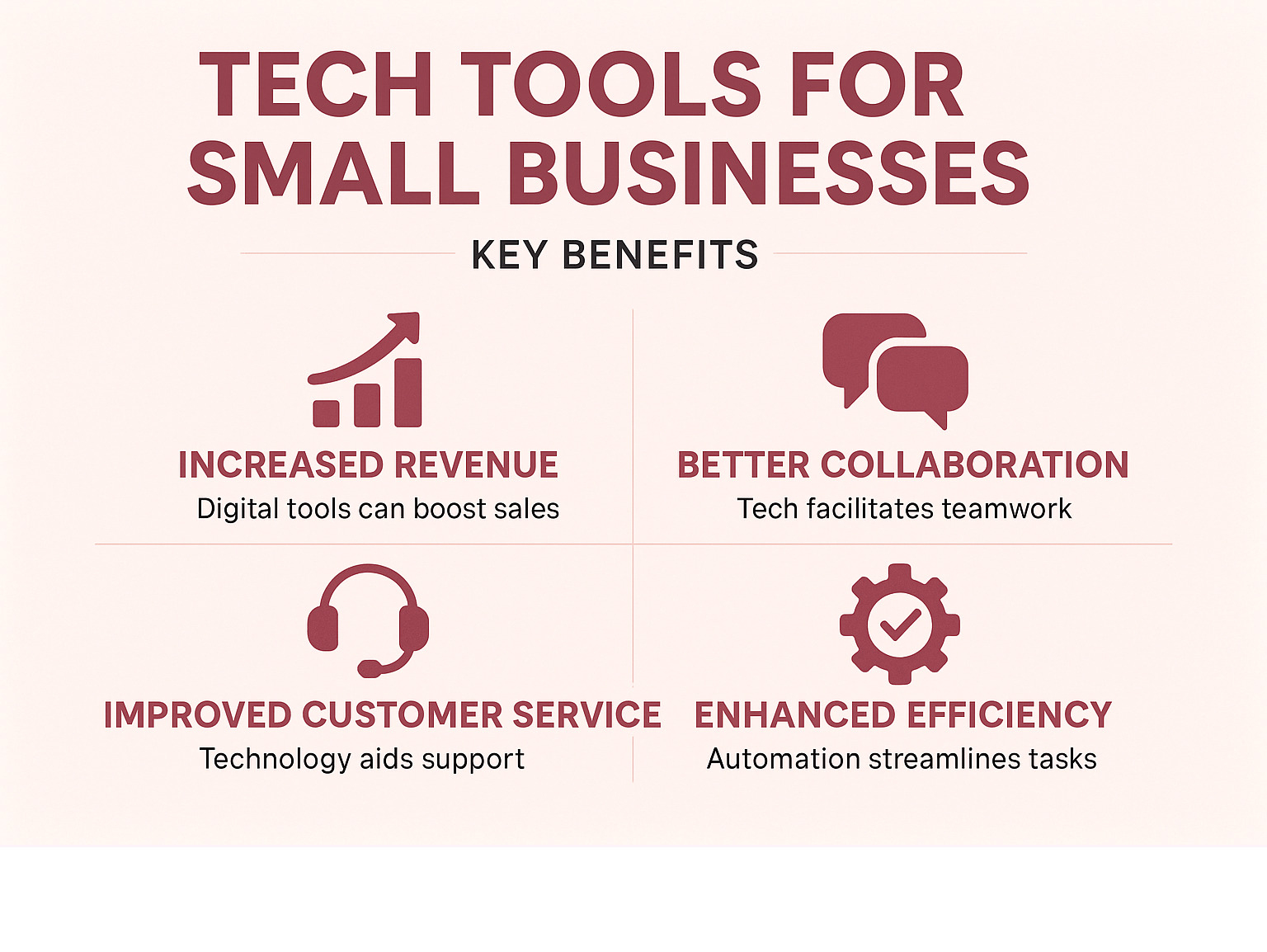
Quick tech tools for small businesses terms:
How to Choose the Right Tech Tools for Your Business
Choosing tech tools for small businesses doesn’t have to be a marathon through endless app stores. Instead, begin with a single question: What is my biggest daily pain point? Tackle that first, then expand your stack one layer at a time.

When you compare options, keep these criteria front-and-center:
- User-friendliness – If your team can’t figure it out in an hour, look elsewhere.
- Integrations – Your CRM, email platform, and accounting tool should share data automatically.
- Automation – Let software handle recurring tasks like invoicing or follow-up emails.
- Scalability – Pick tools that can grow from 5 to 50 users without a total migration.
- Security – Prioritise encryption, MFA, and reliable backups. Learn more about secure cloud options.
- Analytics – Good dashboards turn raw data into clear decisions.
- Support – Test response times during the free trial.
- Budget vs. ROI – A $100 tool that saves 10 hours is cheaper than a $50 tool no one touches.
| Software Category | Key Features to Prioritize | Why It Matters |
|---|---|---|
| CRM | Contact management, sales pipeline | Keeps relationships organised & drives sales |
| Project Management | Task tracking, collaboration | Ensures work stays visible and on schedule |
| Accounting | Invoicing, expense tracking | Clarifies cash-flow & simplifies taxes |
| Marketing | Email, social scheduling, analytics | Reaches customers & measures impact |
| Communication | Messaging, video, file share | Connects teams, especially remotely |
Start small: if email overload is killing productivity, fix communication first. If leads are slipping through the cracks, adopt a CRM. Solve one problem, then stack the next solution on top.
The Essential Categories of Tech Tools for Small Businesses
Below is a condensed tour of the five toolsets most small firms rely on. Skim, choose what plugs your biggest hole, and move on.
Project Management & Productivity
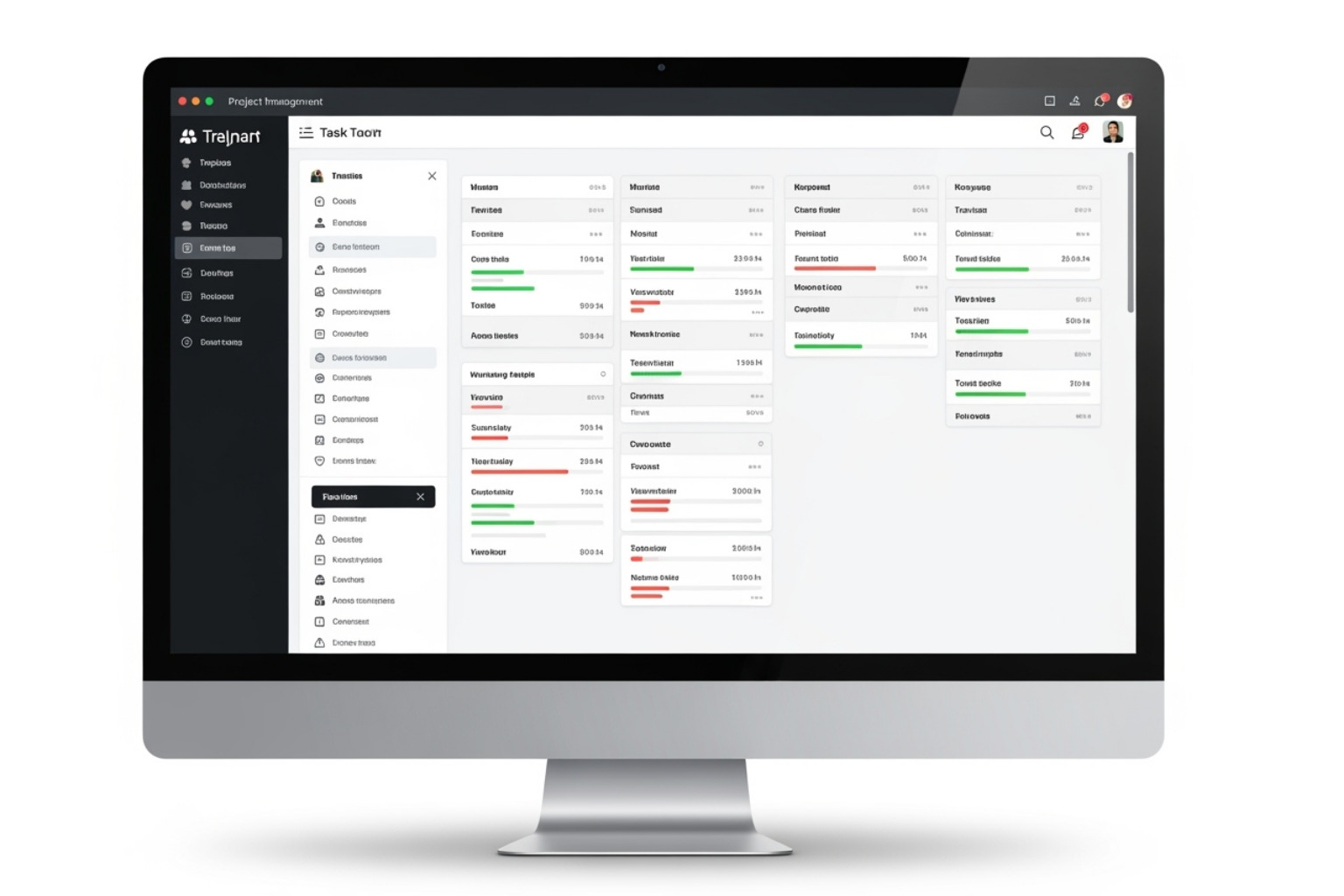
Kanban boards, timelines, and automations keep everyone aligned. For a deep dive, see our Small Business Productivity Tools review.
Popular picks: Asana, Trello, monday.com, ClickUp.
Customer Relationship Management (CRM) & Sales
A CRM is your single source of truth for lead data, deals, and follow-ups––yet only 37 % of sales pros say theirs is fully used. Close that gap with tools that are intuitive and mobile-friendly. Check our CRM Software for Small Business guide.
Try: HubSpot CRM, Zoho CRM, Salesforce.
Marketing & Social Media Management
Schedule posts, send newsletters, and track SEO in one place. 79 % of U.S. consumers still prefer email for brand updates. More tactics live in our Digital Marketing for Startups guide.
Tools worth testing: Canva, Buffer, Ahrefs, Mailchimp.
Finance & Accounting
Automated bookkeeping keeps you compliant and cash-smart. The market is growing fast because owners hate spreadsheets. Compare options in our Cloud Accounting Software Comparison.
Stand-outs: QuickBooks, Xero, Wave, Gusto.
Communication & Collaboration
Whether your team is across town or across time-zones, real-time chat and video are non-negotiable. Zoom alone owns 57 % of the conferencing market.
Staples: Slack, Microsoft Teams, Google Drive, Zoom.
The Rise of AI: Supercharging Your Business Operations
AI is no longer sci-fi––it’s a round-the-clock assistant that never asks for PTO. From automating data entry to predicting sales trends, 74 % of organisations already use some form of robotic process automation.

Why it matters to small firms:
- Time savings – Repetitive tasks run in the background.
- Better decisions – Crunches huge data sets in minutes.
- Always-on support – Chatbots answer FAQs 24/7.
- Fraud detection & forecasting – Spot anomalies before they hurt.
A remarkable 98 % of small businesses already touch AI somewhere, and 54 % plan to spend more this year. The key is purposeful adoption, not fear-driven FOMO.
Starter tools to explore:
- ChatGPT – Brainstorm, draft copy, or summarise research.
- Writer – Keep marketing content on-brand with AI assistance.
- Zapier – Connect thousands of apps; many workflows now include AI steps.
- Keap – Drag-and-drop sales & marketing automation.
- Airtable – Build no-code apps; AI field suggestions are built-in.
Want more? Browse our full AI Tools for Startups roundup.
Navigating the Challenges of Tech Implementation
Adopting new tech tools for small businesses sounds exciting, right? Images of seamless workflows and soaring productivity dance in our heads. But let’s be honest, the journey isn’t always a walk in the park. We’ve seen many businesses stumble during implementation, facing unexpected bumps in the road. It’s a bit like buying a fancy new kitchen appliance – if you don’t quite know how to use it, or it doesn’t quite fit your counter, it just ends up collecting dust.
The good news? You can avoid most of these hiccups with a little foresight and planning! Let’s talk about some common challenges and how to glide past them.
First up, the always-present budget constraints. New technology often comes with a price tag, and it’s not just the monthly subscription fee. You might also need to factor in implementation costs, maybe some new hardware, and definitely training expenses. The trick here is to be smart about your spending. Start with free trials whenever possible to test the waters, prioritize tools with a clear return on investment (ROI), and scale your investment gradually as your business grows. Our Business expense tracking apps guide can be a real lifesaver for keeping an eye on these costs.
Then there’s the human element: employee training and adoption. Your team might feel a bit resistant to change, fearing the unknown or simply feeling overwhelmed by learning something new. Our best advice? Involve your team in the selection process from the start – they’ll be the ones using it daily! Provide thorough and ongoing training, and crucially, highlight how the new tool benefits their daily work. Show them how it makes their jobs easier, not harder. And as the leader, lead by example; your enthusiasm is contagious!
Another common hurdle is integration complexities. Getting different software to “talk” to each other can be tricky, especially if you’re working with older systems. It’s like trying to get two different puzzle pieces to fit when they weren’t designed for each other. To make life easier, prioritize tech tools for small businesses that boast strong, out-of-the-box integration capabilities with your existing systems. For those unique needs where a direct link isn’t available, consider using automation platforms like Zapier, which act as clever connectors between apps.
And in today’s digital world, we can’t forget about data security risks. Moving sensitive information to new platforms, especially cloud-based ones, can raise valid concerns about privacy and potential breaches. Our golden rule: always choose tools with robust security features. Look for things like data encryption, multi-factor authentication, and regular backups. When in doubt, it’s always a good idea to consult a cybersecurity specialist to determine the best steps to protect your business’s valuable data. Peace of mind is priceless!
Introducing new tech also brings with it a temporary disruption to existing processes. Things will inevitably change, and that can lead to some slowdowns or confusion in the short term. Don’t worry, this is normal! The key is to plan carefully. Communicate changes clearly and provide ample support during the transition period. Consider running a pilot program with a small group of users first. This way, you can iron out any kinks before a full company-wide rollout.
Finally, while tech tools for small businesses are incredibly powerful, they are just that – tools. There’s a risk of over-reliance on technology, treating it like a magic bullet that solves everything. It shouldn’t replace critical human oversight or decision-making. Our advice? Use technology to augment your team’s abilities, making them more efficient and effective, rather than trying to replace their intelligence or creativity.
To ensure your tech rollout goes as smoothly as possible, here’s a simplified approach:
- Assess Your Needs: Before you even start looking, clearly define the problem you’re trying to solve or the goal you want to achieve.
- Research and Select: Dive into the options, comparing tools based on their features, what other users say, and how well they can grow with you.
- Pilot Program: Test the chosen tool with a small, enthusiastic group of users. Their feedback will be invaluable.
- Plan the Rollout: Map out a clear timeline and craft a communication strategy that keeps everyone in the loop.
- Train Your Team: Don’t skimp on this! Provide comprehensive, hands-on training that empowers your team.
- Provide Ongoing Support: Set up clear channels for questions and troubleshooting. Your team needs to know they’re supported.
- Monitor and Adjust: Technology isn’t static. Regularly review how the tool is being used and its performance, making tweaks as needed to optimize its benefits.
Frequently Asked Questions about Tech Tools for Small Businesses
What are the must-have tools for a brand-new small business?
- Accounting software – tracks money in/out.
- Project or task manager – organises to-dos and deadlines.
- Communication platform – keeps your team and clients in sync.
- Basic CRM – stores lead and customer info from day one.
- A simple website – your digital storefront.
Choose the order that best matches your industry and cash-flow.
How do I encourage my team to adopt new technology?
- Invite them into the selection process.
- Offer hands-on training plus quick-reference guides.
- Emphasise “what’s in it for me” benefits.
- Pilot with a small champion group.
- Lead by example and provide ongoing support.
How much should I budget for technology?
Budgets vary by industry, size, and growth stage, so there’s no magic percentage. Start with the essentials, track every subscription with business expense tracking apps, and judge tools by ROI rather than sticker price.
- Begin with free tiers or trials.
- Scale spend only when the tool proves its value.
- Re-evaluate your stack quarterly to cut waste.
Smart, incremental investment beats giant one-time splurges every time.
Conclusion: Build Your Perfect Tech Stack for Success
Phew! We’ve covered a lot of ground, haven’t we? By now, it’s clear that in today’s business world, tech tools for small businesses aren’t just nice-to-haves; they’re the very engine driving efficiency, productivity, and incredible growth. We’ve seen how these digital advancements can truly transform your day-to-day, from streamlining operations and sparking better collaboration to empowering you with data-driven decisions that ultimately boost your bottom line.
Our core takeaway? Think of your tech strategy not as a chore, but as an exciting opportunity. It’s not about collecting every shiny new tool on the market. Instead, it’s about being strategic. Start by pinpointing your most pressing needs, then carefully choose tools that are wonderfully user-friendly, play nicely with your existing systems (hello, integration!), and can comfortably grow with you (that’s scalability!). The real magic happens when you build a cohesive system that truly works for you, freeing up your valuable time and precious resources.
Indeed, the right tech stack isn’t just a collection of software; it’s a powerful competitive advantage. It empowers you to operate smarter, serve your cherished customers even better, and adapt with impressive speed to market changes. As your entrepreneurial journey continues and your business blossoms, remember to regularly check in on your tools. Are they still meeting your evolving needs? A quick re-evaluation can keep you perfectly ready for what’s next.
Ready to dive even deeper and open up more resources to build your ultimate tech arsenal? You’re in the right place! Explore our Tech category right here on TheEntrepreneurs.net. You’ll find a treasure trove of more guides, insightful reviews, and expert tips designed specifically for amazing small business owners like you. Let’s build something truly amazing, together!